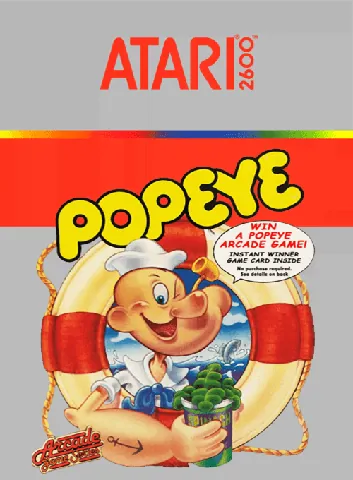
Popeye
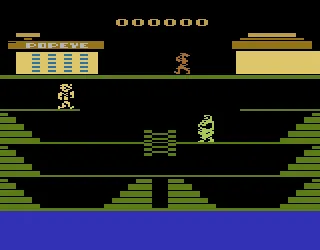
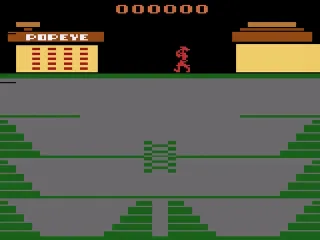
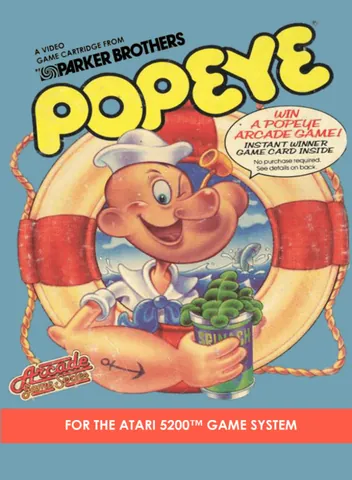
Popeye was released in 1983 by Parker Brothers as a port of Nintendo's successful arcade game, in which the player, as the famous sailor, tries to collect hearts, letters, and musical notes dropped onto the screen by his sweetheart Olive Oyl, while dodging the villainous Bluto, an aggressive vulture, and other enemies. Each of the distinct screens offers a different layout of platforms, ladders, and obstacles, so the player must constantly adapt their route for collecting items and dodge thrown bottles and other flying objects that Bluto sends to make progress as difficult as possible.
A key game mechanic is eating spinach, which grants Popeye superhuman strength for a limited time and the ability to knock out Bluto with a single punch. This temporary transformation adds a tactical layer, since the player must decide when to use the ability most effectively rather than relying on it automatically at every encounter with an enemy. The Atari 2600 version had to simplify the graphics and color palette compared to the arcade original and reduce the amount of on-screen detail, yet it managed to carry over the core gameplay loop and the recognizable characters from the comic strip license so that players could instantly tell what game they were playing, right down to Popeye's signature look and his pipe.
Popeye was among the popular licensed titles for the Atari 2600 in the mid-1980s, benefiting from the character's popularity and the era's boom in arcade platformer ports to home consoles. Today it's interesting mainly as evidence of how developers sought ways to bring more complex arcade concepts to limited hardware, and for collectors it remains an enjoyable example of the genre in its early era, as well as a solid take on a popular comic and film license on a modest technical foundation - something rival companies didn't always manage with the same care at the time.
Why play it: For collectors and fans of the early era of licensed games, it's a solid take on a popular comic and film character on the Atari 2600's modest technical foundation.
Game 36 of 69 for Atari 2600