Rampart
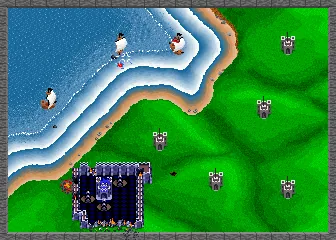
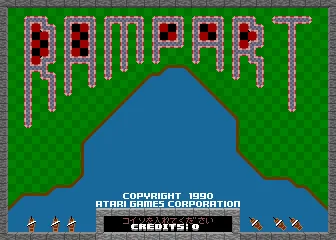
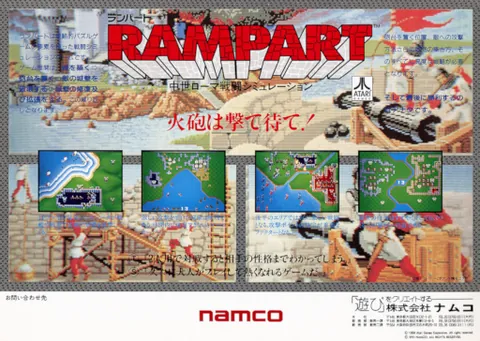
In 1990, Atari Games bet on an unusual combination of genres, and the result was Rampart, in which the player alternately fortifies the coastline and repels attacks from enemy ships. Each round is split into two phases: first an artillery battle, where the player places cannons and bombards the opponent's walls, then a building phase in which falling shapes similar to those in Tetris are used to repair the walls and expand the player's territory so more gun batteries can be built.
This two-phase structure gave the game an unusual rhythm – the tension of direct fire alternated with a calmer, more deliberate building segment, where it mattered how efficiently the player closed off the walls in order to build another tower, and whoever failed to repair their fort in time lost both territory and cannons in the next barrage phase. The cabinet also supported up to three players at once via trackball, so it was possible to play against the computer as well as against two other opponents simultaneously, making it a popular choice for battles among friends and strangers alike in the arcade.
Thanks to its mix of strategy and action, Rampart stood out from the usual arcade lineup, which at the time was dominated by fast reflex-based titles, and it later received ports to home consoles and computers, where it found its own circle of fans who appreciated precisely this combination of calm and tension. In the history of the genre, it is cited as one of the first successful attempts to combine building mechanics with straightforward arcade action into a single balanced whole that works just as well against the computer as it does between human players.
Why play it: For its inventive alternation between building and combat phases, which had no equivalent in arcades in 1990.
Game 123 of 258 for Arcade
The same title elsewhere (2)
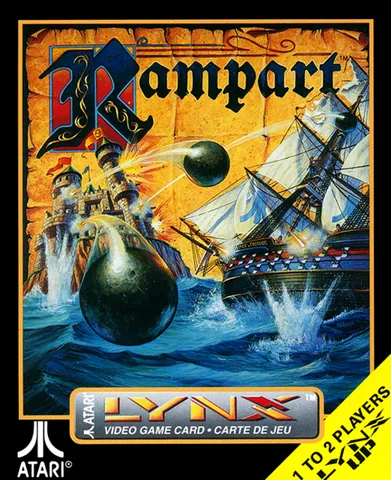
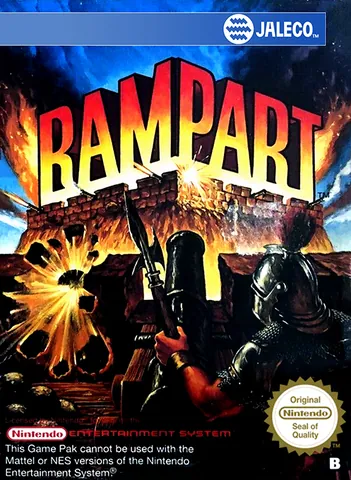
Atari Games' arcade original was controlled with a trackball, letting players aim their cannons smoothly and precisely, and it supported multiple players at a single cabinet. Home ports had to replace the trackball with a directional pad or joystick, making aiming choppier and less precise, though the core loop of building walls, placing cannons and firing remains intact. The portable Atari Lynx version additionally shrank the battlefield to fit the handheld's small screen, which keeps things readable but sacrifices some spectacle. For the most precise way to play Rampart, the arcade original with its trackball is the pick; the Lynx version suits gaming on the go, with compromises in clarity and battlefield size.