Daley Thompson's Supertest
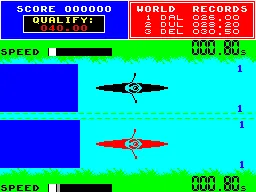
Daley Thompson's Supertest followed on from the successful Decathlon and expanded the multi-event sports game concept with an even wider range of disciplines, from classic running and long jump through rowing to unconventional tests of strength and dexterity. The game was designed as a competition for up to four players, who took turns at the keyboard or joystick in each round, making it a popular pastime at parties and school breaks, where the main point was who would still be standing last without wrecking the controller.
Controlling most disciplines relied on rapid alternating button mashing or rhythmic joystick waggling, a typical, if physically demanding, way of controlling sports games in the mid-1980s that could thoroughly tire out a wrist in a single afternoon and more than once damage a less sturdy joystick. The graphics remained simple but functional, with clearly readable athlete sprites, and the game placed emphasis primarily on competitiveness between players at a single computer rather than on playing against the computer or on the depth of individual disciplines, which were designed so that absolutely everyone could grasp them on the first try and join the contest immediately.
Supertest was received as a worthy sequel to the popular Decathlon and earned praise especially for its variety of disciplines and multiplayer fun, though it never quite managed to eclipse the success of its predecessor in the eyes of players and reviewers of the time. Today the game comes across as a typical representative of the 1980s button-mashing sports genre, but as social multiplayer entertainment around a single Spectrum it retains its charm to this day, and it recalls an era when a whole group of friends shared one joystick and competitiveness mattered more than flawless graphics or the depth of individual disciplines, which players didn't even expect back then.
Why play it: For a group of friends around a single Spectrum, where competitiveness matters more than flawless graphics – social fun across disciplines that has kept its charm to this day.
Game 88 of 100 for ZX Spectrum