Berzerk
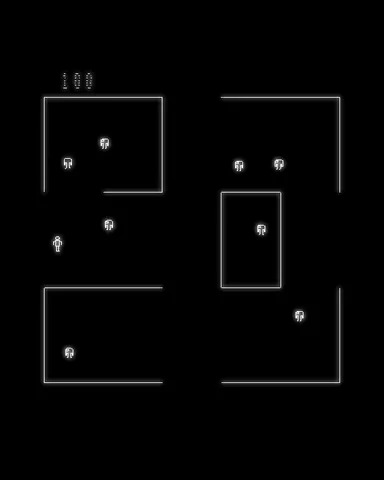
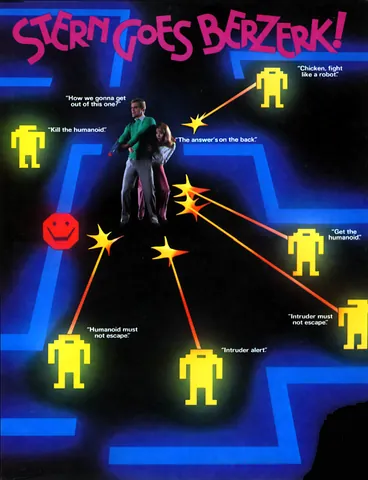
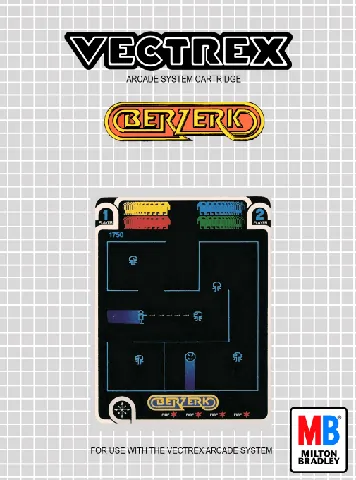
Berzerk sends the player into an endless maze of electrified corridors inhabited by shooting robots. The concept is simple and merciless: each room has several exits, a character with a gun stands inside, along with a cluster of robots that move slowly and fire. There are three ways to kill them – with your own shot, by luring a robot into a wall, or by having the robots accidentally shoot each other. The walls themselves are electrified, so even a careless step means instant death. If the player lingers too long in a room, the bouncing smiley face Evil Otto appears – indestructible, able to pass through walls, and gradually speeding up. He isn't really an opponent; he's a countdown clock wearing a grin – and it's precisely him that turned Berzerk into a game about constant forward motion.
The Vectrex conversion takes advantage of the vector monitor drawing thin glowing lines: the maze looks like a shining wireframe blueprint, the robots are angular figures assembled from a handful of segments, and shots are short bright lines that are easier to track in motion than on raster systems. The Vectrex's analog stick lets you aim in eight directions while moving at the same time, which is essential for this type of game. The arcade cabinet was famous for its synthetically speaking robots; the home version has to make do with sparse electronic sounds, which nonetheless do a good job underscoring the oppressive atmosphere of the empty corridors.
Berzerk is often called the forefather of the arena shooter genre, and its legacy shows up anywhere a player fights through enclosed rooms full of enemies. At the time, the Vectrex conversion was well received precisely for its precise controls. Today it's appreciated as a pure game of spatial reasoning: deciding which exit to take is ultimately often more important than the aiming itself. Clearing a room doesn't mean success, because the next one is always a little more densely packed, and a single wrong step sends the player back to the start. It's exactly that combination of simple rules and zero tolerance for mistakes that keeps Berzerk alive today.
Game 3 of 13 for GCE Vectrex
The same title elsewhere (3)
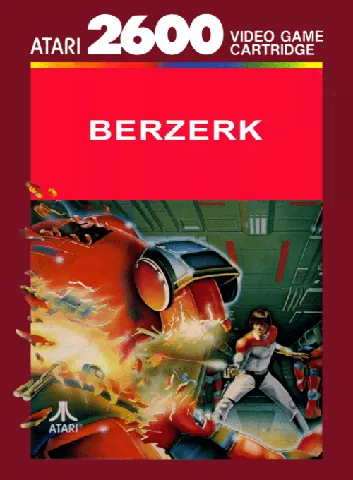
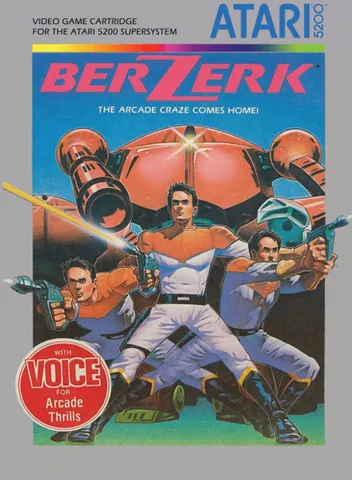
Stern's arcade original was famous for its digitized robot voices and vector graphics, and that's exactly what sets the home conversions apart. The GCE Vectrex version ran on its own vector display, so it kept the sharp, glowing lines close to the arcade look, albeit without the voice work. The Atari 2600 version had to replace the vector graphics with cruder raster drawing, fewer details, and simplified robots, and the sound was also noticeably more limited. Anyone wanting the experience closest to the arcade cabinet should pick the Vectrex; the Atari 2600 offers a simplified but still playable alternative.