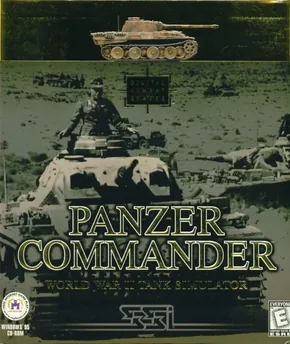
Panzer Commander
Panzer Commander took the player through tank warfare on both the Eastern and Western fronts of the Second World War in the form of two separate campaigns, one for the German Wehrmacht and the other for the American army, following the fate of one particular tank commander from the early battles through to the later stages of the conflict. The player could switch between the positions of commander, gunner, and driver, direct the movement of the whole unit within a smaller formation, and carry out missions ranging from reconnaissance and defending key points to breakthrough attacks against fortified lines.
The game worked with fairly open battlefields where using terrain, forests, and villages as cover mattered, and it offered a damage model that distinguished individual parts of the tank, so that even a seemingly survived hit could knock out the crew or the main weapon. The graphical rendering of the terrain and vehicles was solid for the end of the nineties, and the sound design, with the rumble of engines, the crack of turrets, and crew callouts in the appropriate language, nicely conveyed the atmosphere of armored combat on an open front, whether it was the snowy plains in the east or the French countryside in the west. The differing climate and terrain conditions of the two theaters also called for a different approach to tactics, which gave the campaigns some welcome variety.
Panzer Commander is remembered today as one of the more ambitious tank simulators of its generation thanks to its two full-fledged campaigns from different points of view on the war and its emphasis on the personal story of a tank commander making his way through the conflict. For fans of World War II armor, the game remains an interesting choice even today, especially thanks to the variety of environments between the two theaters and the honest tank-combat model fitting for its era. The ability to experience the war from both the German and the American crew's perspective also gave players a more complete picture of how armament, tactics, and deployment conditions differed for armored units on both sides of the front.
Why play it: Thanks to two full-fledged campaigns from the German and American perspectives and an honest tank-combat model, it will appeal to fans of World War II armor who value seeing both sides of the front.
Game 150 of 229 for PC / Pentium a Windows 9x