
Dandara

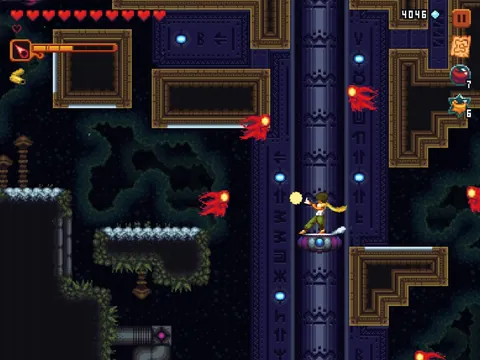
Dandara ranks among the metroidvanias unafraid to challenge the genre's basic rules – the main heroine can't walk or jump normally at all, but instead teleports between illuminated surfaces and can attach herself to the ceiling, a wall, or the floor depending on where the player aims. This unconventional movement system also changes the logic of combat and exploration, since the player must constantly think in terms of every side of a room, not just left to right. On touch controls this initially demands more from the player, but once you've mastered the basics, it makes Dandara one of the freshest platformers of its kind.
The Brazilian studio Long Hat House built a world called Salt as a crumbling civilization full of oppression and forgotten corners, which the player gradually unlocks by collecting new abilities – the classic metroidvania principle, just delivered in a black-and-white, high-contrast visual style with bold color accents. The atmosphere is heavier and more melancholic than in most genre touchstones, which sets the game apart visually too and gives it a distinctive tone.
The game was released first on consoles and PC, and the mobile version then brought the same content adapted for touch controls, including the option to connect an external gamepad for more precise teleportation control. The port succeeded, with the game retaining its pace and difficulty, only requiring a bit more patience when playing purely on a phone display.
Why play it: A tip for metroidvania fans looking for a genre entry with a genuinely different movement core, not just a cosmetic tweak, even though mastering the touch controls takes a bit of practice.
Game 290 of 363 for Mobil (iOS a Android)