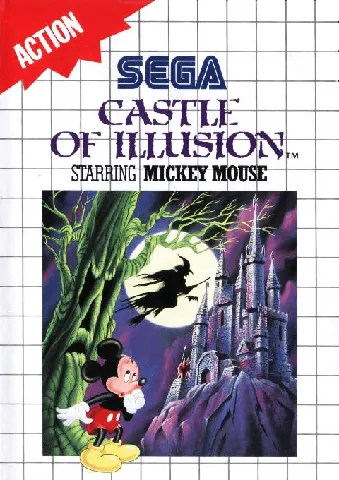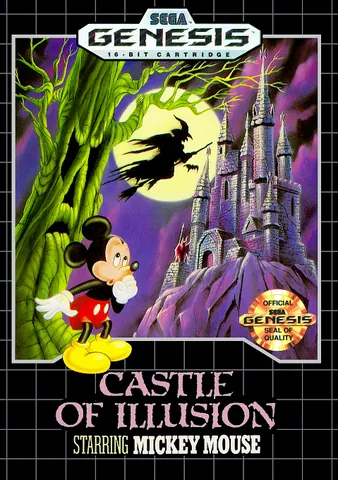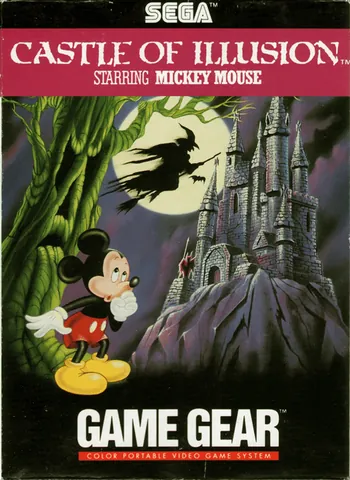
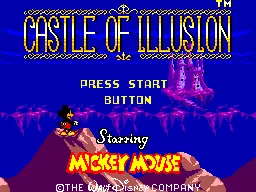
When Mickey Mouse first jumped his way through a castle full of magical traps, he proved that even a licensed game with a mascot could be a genuine platforming delicacy. Castle of Illusion Starring Mickey Mouse ranks among the most beloved titles ever released by Sega, and the version for the Game Gear brought this fairy tale into your pocket in full color.
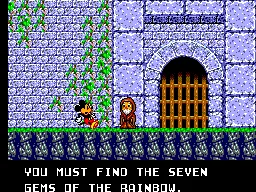
The story is simply straightforward: the evil witch Mizrabel has kidnapped Minnie and Mickey sets out to rescue her across an enchanted castle. What makes the game exceptional is its craftsmanship. Mickey doesn't attack with fists or a sword but jumps on opponents' heads or throws collected items at them — apples, marbles, sugar cubes. The controls are supple, the levels are full of imaginative environments from forests through a library with toys coming to life to a candy world, and each level has its own visual identity.
On the Game Gear the game shares its foundation with the version for the Master System, yet the handheld's color display gives it a hallmark that the black-and-white competing pocket consoles of the time couldn't offer. The color palette that Sega became famous for shines here: the castle literally glows and Mickey's animations — from his sheepish stumble to his triumphant gesture — are among the most adorable the 8-bit era ever produced.
The title's magic lies in the balance between accessibility and challenge. The game is kind enough for even a younger player to manage, yet it hides enough tricky passages and bosses to absorb seasoned platforming veterans too. It's the type of design Sega mastered almost perfectly at the time — the joy of playing is both instant and lasting.
To this day Castle of Illusion is considered one of the peaks of Mickey's gaming career, and in 2013 it received a complete modern remake that retold the same fairy tale in 3D. That's the best proof that the original design had timeless quality.
Why play: A charming, craftsmanlike platformer with unmistakable Sega charm that, even on a small display, offers one of the prettiest pocket fairy tales of its time.
Game 14 of 39 for SEGA Game Gear
The same title elsewhere (2)
The Mega Drive version is the original and remains the best-known, most visually lavish take on the game, with fluid animation and a memorable score. The 8-bit Master System version, though, is not merely a trimmed-down port — it is a separately designed game with its own level layouts, tailored to the weaker hardware: fewer colours, simpler backgrounds and a thinner soundtrack, yet it still ranks among the finest platformers on that console. The handheld Game Gear edition sits closest to the Master System version, sharing its related Z80 chip and much of its level design, but with a smaller screen resolution and an even narrower colour palette, most noticeable in the background detail.