Rhythm Tengoku
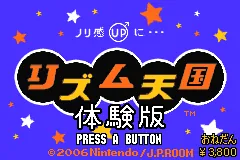
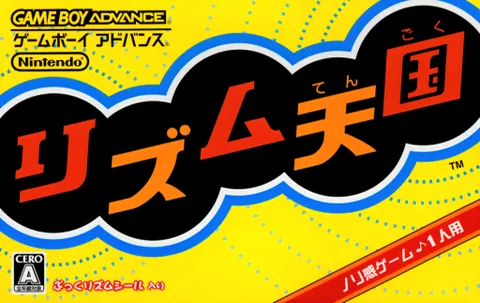
Imagine someone shoving a handheld console into your hand and saying: now you mustn't watch the screen with your eyes, but with your ears. That's exactly how Rhythm Tengoku works, one of the boldest and most infectious rhythm titles ever released on the Game Boy Advance. The game bombards you with short mini-games in which the only thing that matters is the correct timing of a button press to the beat.
The mechanic is seemingly trivial, and that's precisely where its genius lies. You'll handle most actions with a single A button (or the D-pad), but the rhythm you have to hit is often deliberately hidden, syncopated, or the game strips away the visual cue after a while and leaves you to rely solely on your hearing. The individual mini-games have utterly crazy, surreally Japanese premises, and each has its own melody that burrows into your head for the whole day.
The developmental context is the most interesting thing about the entire game. Behind the project stands the famous musician and producer Tsunku in collaboration with the team around Kazuyoshi Osawa at Nintendo, that is, the people who later also stood behind the WarioWare series. It's no coincidence that Rhythm Tengoku shares that hectic structure of short challenges with WarioWare. The game came out in Japan in 2006 as one of the last major titles for the GBA, at a time when the successor Nintendo DS already reigned.
Culturally it's a cornerstone of the entire later Rhythm Heaven series (Rhythm Paradise in Europe), which on the Nintendo DS, Wii and 3DS grew into hundreds of thousands of copies sold worldwide. The original Game Boy version, however, never officially left Japan, which made it a little legend among collectors and import fans, one long tended to in the West through fan translations.
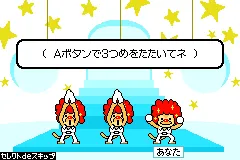
The graphic style is also characteristic: a clean, flat cartoon aesthetic with bold colors and minimalist characters, which became the visual signature of the entire series. The game proves that the limited GBA hardware could offer an experience that stands and falls on design and music, not on technical spectacle.
Why play: If you want to understand where the perfectly tuned Rhythm Heaven series came from, you have to start right here with the addictive, funny and ear-pleasing original.
Game 54 of 170 for Game Boy Advance