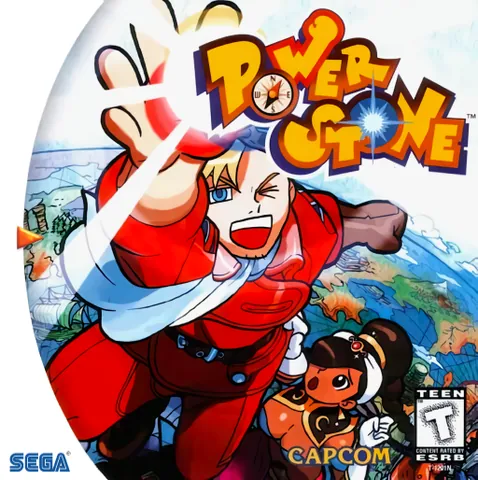
Power Stone
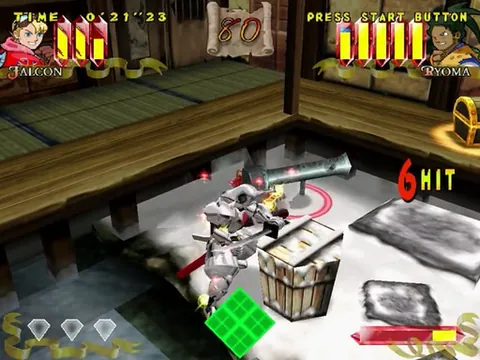
When the SEGA Dreamcast was looking for a game to show off everything that little white console could do, Capcom answered with Power Stone, a fighting game unlike any that had existed before. Forget static duels on two planes. Here the brawlers move freely in fully three-dimensional arenas, climb walls, hurl furniture at each other, and the entire environment becomes part of the battle.
The game was created at Capcom and originally appeared in arcades on the Naomi system, which shared its architecture with the Dreamcast, so the conversion to the home console was almost lossless. In 1999 that was a stunning lure: arcade quality right in the living room. Power Stone immediately captivated players with its freshness and colorful, slightly comic-book style that distinguished each of its vivid characters.
A key mechanic gave the game its name. Gems, the so-called Power Stones, appear around the arena, and once a player collects three, their character transforms into a super-powered version of themselves with devastating special attacks. This transformation turned the course of a fight on its head and forced players to fight not only against each other but also for control of the scattered stones. The bouts were thus chaotic, fast, and always unpredictable.
Thanks to the ability to use objects from the environment, from chairs and barrels to explosives, Power Stone became the ideal game for two players on the couch. It was not a title for tournament veterans hunting frame-perfect combos, but spontaneous, action-packed fun where even an inexperienced player could beat a friend through a lucky break. This accessibility became its greatest asset.
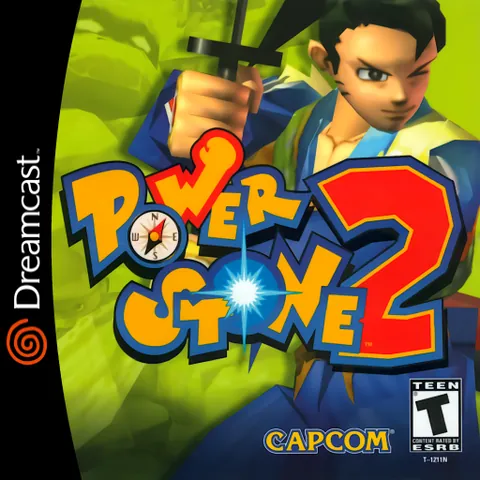
Power Stone quickly became one of the darlings of the Dreamcast library and today ranks among the games fans cite as proof of why the SEGA console was so exceptional. The series continued with Power Stone 2, and both games later received a collector's compilation on the PSP. For many players it remains a symbol of the era when SEGA could still afford to experiment.
Why play: For the freedom of fully 3D arenas and chaotic, instantly graspable fun that excels above all with two players.
Game 32 of 54 for SEGA Dreamcast