Burn:Cycle

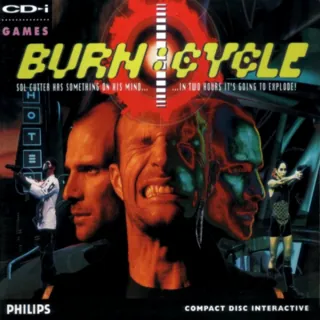
Burn:Cycle is the best calling card for what the Philips CD-i could do at a time when people believed the future of games lay in interactive film. The player takes on the role of data thief Sol Cutter, who picks up a virus in his head during a heist. From that moment a roughly two-hour countdown starts, after which the virus will destroy his brain, and the whole game is one long escape through a city full of corporations, hackers, and strange cybernetic beings. The gameplay combines movement through pre-rendered environments, collecting and using items, conversations, and several mini-game interludes, from flying through data tunnels to logic puzzles involving locks and security systems.
Technically it's an impressive piece of work: the combination of drawn animation, computer graphics, and smoothly played video from disc was among the best that ran on a home device in the mid-nineties. The sound is even stronger, since the game rests on an electronic soundtrack that doesn't just accompany the action but sets the whole mood and drives the pace of the escape. The atmosphere is tense, mesmerizing, and thoroughly cyberpunk, closely related to the films and books that shaped the genre at the time.
At the time, Burn:Cycle was among the best-reviewed titles on the whole platform and became a game retailers used to demonstrate what the CD-i could do. It was later ported to personal computers, reaching audiences beyond the narrow base of Philips owners. Today it's kept afloat mostly by its style: the story can be finished in one longer afternoon, the puzzles are never especially harsh, and the time limit gives the pacing an urgency that many other FMV games lack. Anyone who wants to see the one title that fully exploited what the new medium could do on the CD-i should start with this one. It has also aged better than most contemporary attempts at interactive film, because instead of relying on live actors it bets on stylized animation and a world that doesn't feel cheap even after thirty years.
Game 5 of 13 for Philips CD-i