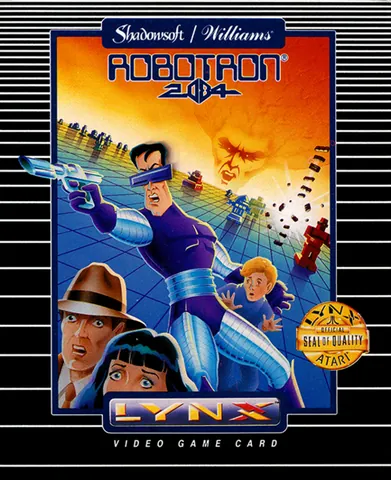
Robotron 2084
Two sticks, thousands of enemies and a single goal: to survive one second longer. Robotron: 2084 is the purest distillation of arcade action ever created, and its arrival on the Atari Lynx in 1991 was a small miracle of engineering. Williams' 1982 original was built on a brilliant control scheme no one else had at the time: one stick moves you, the other independently aims and fires. On a handheld this meant cramming two directional controllers into a single box under your thumbs, and the Lynx pulled it off surprisingly well.
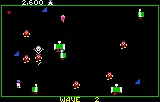
The principle is brutally simple and all the more addictive for it. You find yourself in the middle of a screen flooded with hordes of robots trying to crush you, while the last human family runs around the edges, whom you try to save before the Brains convert or kill them. There's no story, no menu full of options, just pure reflex, peripheral vision and the ability to read the patterns of chaos. Every run looks different, because the enemies swarm dynamically and you learn when to dodge, when to shoot and when to sacrifice a civilian for your own survival.
It's precisely this endless replayability that makes Robotron a legend. The game has no ending in the traditional sense, just a growing number of waves and your personal score as the only measure. It's the embodiment of that famous "just one more try" feeling, when you die, pound your fist on the table and instantly hit the button for a new attempt. On a portable console, played in short bursts, it was the ideal format.
The Lynx version also showed something important for the whole platform: that a complex, fast arcade game needn't be the preserve of big cabinets in the arcades. That even in your pocket you could carry adrenaline capable of racing your heart. At a time when the rival Game Boy offered slower, more deliberate experiences, Robotron on the color Lynx was proof that Atari's handheld was aimed at players who wanted a real punch.
Today Robotron: 2084 is written into game-design textbooks as a model of purity and instant clarity. Its twin-stick mechanic influenced dozens of later titles from Geometry Wars to independent arcade shooters. The Lynx port isn't the most famous version, but it's a testament to the ambitions of a console that wasn't afraid to reach for the most demanding arcade jewels.
Why play: For genuine twin-stick action adrenaline in its purest form, where only reflexes and a cool head amid the chaos count.
Game 11 of 30 for Atari Lynx
The same title elsewhere (1)
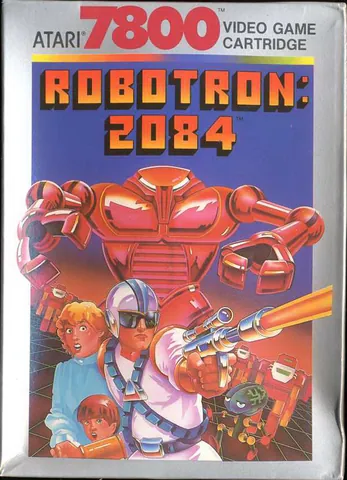
The arcade original was built around two separate joysticks — one for movement, one for firing in any direction independent of walking — which gave the game its uniquely fluid chaos. The Atari 7800 tried to replicate that by letting players plug two joysticks into both of the console's ports at once, an unusually faithful solution for a home conversion of its era. The 8-bit machine shows fewer enemies on screen at a time, and both graphics and sound are noticeably simpler than on the arcade board's dedicated hardware. For the pure adrenaline of twin-stick control, the arcade cabinet remains the reference, but the Atari 7800 version counts among the era's remarkably honest home ports.