Q*bert
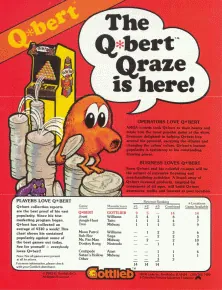
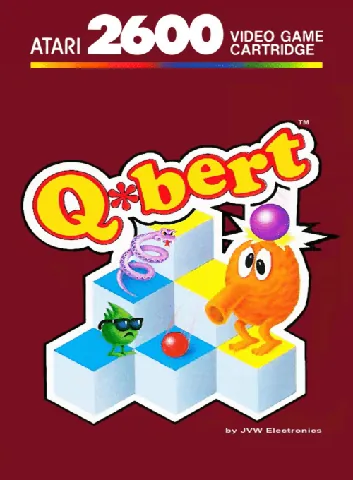
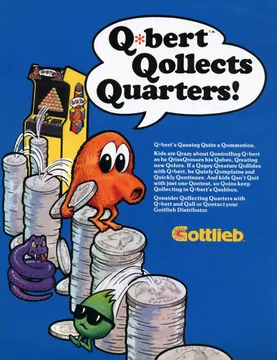
Q*bert arrived on the Atari 800 in 1983 in a conversion published by Parker Brothers based on the successful arcade machine from Gottlieb. The player controls an orange creature with a trunk-like snout who hops across a pyramid of hexagonal cubes and must recolor all of them to the target color while avoiding the snake Coily and other enemies that move around the pyramid in different ways. Flying discs can help by letting the player jump onto them in an emergency and escape from the edge of the pyramid away from pursuers, though using them costs precious seconds and part of the score, so experienced players save them only for truly critical situations.
A defining feature of the game is its isometric view of the pyramid, which takes some getting used to when judging the direction of jumps, but also gives the game a distinctive visual style that set it apart at first glance from most contemporary arcade games built on a classic top-down or side view. The Atari version tried to faithfully replicate the arcade original's vivid color palette and characteristic sound effects, including Q*bert's famous "cursing" when falling off the pyramid, expressed through a speech bubble with unintelligible symbols. The pace accelerates with every level, and enemies with different behaviors keep appearing, forcing the player to constantly adapt their jumping strategy and make decisions in a rapid sequence of seconds.
Qbert was among the most popular arcade brands of the 1980s, and its home conversions on platforms like the Atari 8-bit helped spread the character's popularity beyond arcades. The game is valued for its simple yet addictive principle combining fast reflexes with spatial reasoning. Even today, Qbert remains easy to grasp and fun, a good demonstration of how powerful arcade concepts built around a single strong idea and a distinctive character can be.
Why play: For a simple yet addictive arcade concept combining reflexes with spatial reasoning — easily accessible fun built around one strong idea and an unmistakable character.
Game 58 of 124 for Atari 800 / 8-bit
The same title elsewhere (2)
The Gottlieb arcade cabinet had its own speech-synthesis chip, letting Q*bert curse in those gibberish speech bubbles with actual voice, while rendering the pyramid as shaded, colored cubes that gave the image real depth. The Atari 2600 version, limited to the TIA sound chip's two channels and a thin color palette, had to drop the speech entirely — the character just beeps — and the cubes appear flat, without shading. It still ranks among the better conversions of its day: the jumping and pacing survive intact, only the visuals and audio fall short of the arcade board. To hear Q*bert's real mumbling, the arcade version is the one to seek out.