Tower Toppler
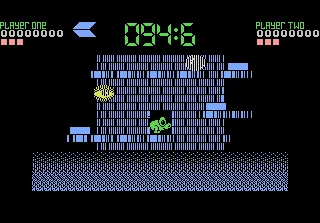
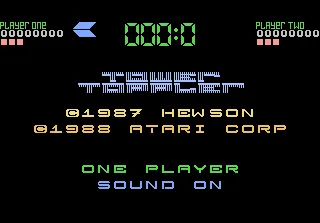
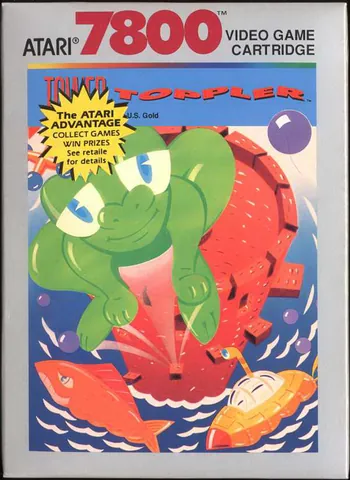
Tower Toppler sends the player to the top of a series of giant towers wrapped in spiral platforms, along which the character moves left and right, dodging obstacles and falling objects while trying to get as low as possible toward the base of the tower before dangerous forces rising from below catch up. The unusual cylindrical perspective, in which the world rotates around the tower's axis, gives the game an unusually spatial feel for its time and forces the player to constantly keep track of what's happening around the corner of the visible part of the screen, where unexpected threats often appear. Each tower also hides its own set of obstacles and enemies, so the player can't rely solely on patterns learned from previous levels and must stay alert throughout the descent.
On the Atari 7800 the game works surprisingly well thanks to the smooth rotation of the scenery, with color-coded bands of the tower helping orientation and different types of obstacles – from moving platforms to dangerous creatures – keeping the pace varied throughout the descent. The musical themes are cheerful and playfully light, which contrasts with the pressure of the time limit and the need to move quickly so the character isn't caught by rising water or another threat from the base of the tower, relentlessly pushing the player forward. At the end of each tower there's also a short finale that requires a different approach than the descent itself.
The original European version of the game, known as Nebulus, was praised precisely for its original cylindrical take on the platformer genre, which wasn't seen much elsewhere at the time and offered a refreshing perspective on an established genre. The North American release as Tower Toppler, including the Atari 7800 version, brought this unconventional concept across the ocean and widened the circle of players who got to experience the unusual design without having to seek out imported European versions. Today the game stands out precisely for its visual distinctiveness from ordinary side-view platformers and offers a pleasant challenge even decades later.
Why play it: For its unconventional cylindrical take on the side-view platformer, which even decades later offers a visually distinctive and pleasantly challenging experience.
Game 18 of 37 for Atari 7800