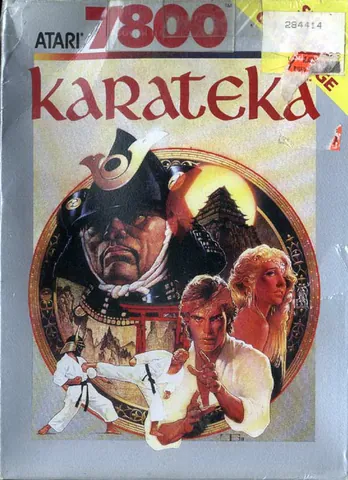
Karateka
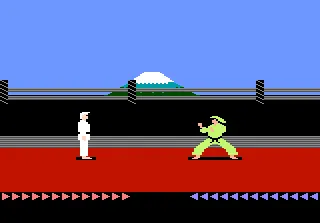
Karateka tells a simple but effective story of a fighter who must battle his way through a series of duels to a fortress where a kidnapped princess is held prisoner. The game plays out as a gradual progression through scenes from left to right, where individual guards await the player one by one, engaging in duels based on timing strikes, blocks, and dodges. Unlike many contemporary fighting games, Karateka emphasizes observing the opponent's movement and reacting precisely rather than chaotic button-mashing, and a single careless moment can knock the hero to the ground with one blow. Along the way to the fortress, time also runs relentlessly, so the player can't proceed too cautiously or linger longer than necessary.
On the Atari 7800, the game preserves the fluid character animation that was already praised in the original as unusually realistic thanks to the rotoscoping technique used to transfer motion, where character movements were derived from actually filmed human motion. The duels are clear and legible; the musical theme in the opening scenes creates a ceremonial, almost cinematic atmosphere, while the duels themselves play out mostly in silence broken by the sounds of strikes, heightening the sense of focused tension. This restraint in sound lets the player concentrate on reading the opponent's movements, which is crucial for success, since any hesitation is punished immediately.
The original Karateka on computers was praised in its time precisely for its cinematic storytelling without a single line of text dialogue and for the fluidity of its animation, which in many respects foreshadowed the later action-adventures of the same author, who would later become even more famous for a work with even more elaborate movement. The Atari 7800 version made this approach accessible to console players as well, and even with simpler controls it retains the tension of balancing attack and defense. Today the game feels like a short but tightly crafted demonstration of how a story can be told purely through movement and combat choreography, without a single line of text.
Why play it: For a short but tightly crafted demonstration of storytelling through pure movement and combat choreography without a single word of text, ideal for fans of cinematically styled action-adventures.
Game 16 of 37 for Atari 7800
The same title elsewhere (2)
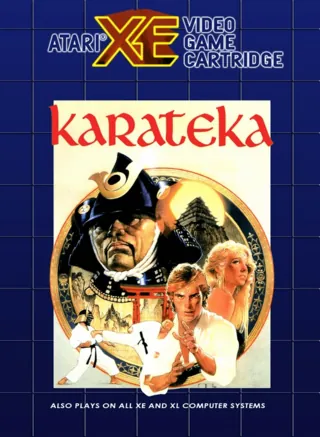
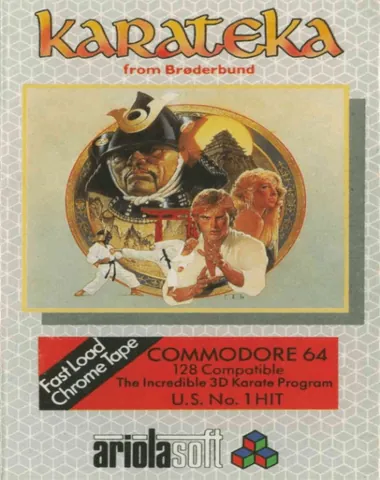
Karateka became famous for its cinematic combat direction and smooth hero animation, which placed heavy demands on the performance and memory of 8-bit machines. The Commodore 64 version is still prized by fans mainly for its dramatic opening theme, which the SID sound chip renders with richer harmony and a fuller sound than the POKEY chip found in Atari's 8-bit computers. The Atari version, in turn, can rely on faster, more direct graphics handling that the system was originally built for, so the duels and the walk through the castle feel just as smooth as on the C64. Both versions keep the same dramatic structure of the game, differing mainly in the character of the sound and small technical details.