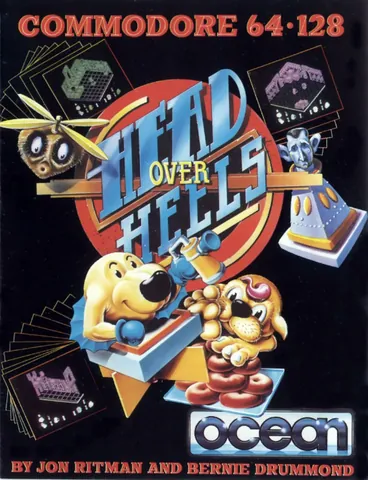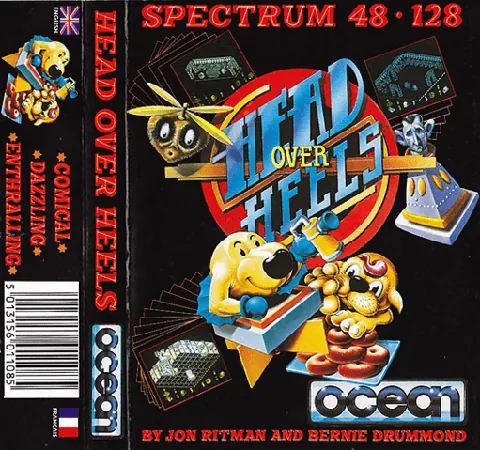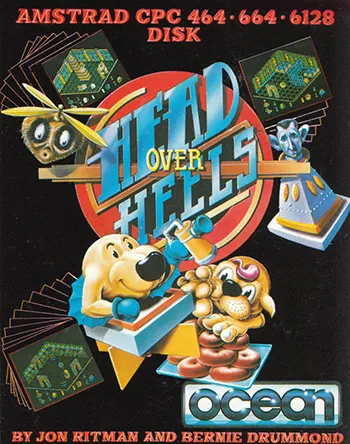
Head over Heels
Two characters, one head and one pair of legs, and a world you can't conquer any way other than through their cooperation — Head over Heels is one of the most ingenious isometric puzzle adventures of the 8-bit era. On the Amstrad CPC it moreover ran in a prettier, more colorful form than the one the ZX Spectrum offered, because the CPC boasted a richer palette.
The game's ingenious idea lies in controlling two heroes with different abilities: Head can jump high and shoot, Heels runs fast and carries objects. At first you control them separately, but once they join, a single being is created combining both sets of skills — and only then do most of the puzzles open up. This mechanic of two bodies cooperating was extraordinarily original for its time.
The world is made up of a network of isometric rooms in which you solve logic tasks: you carry objects, activate switches, seek the right sequence of steps and combine both characters' abilities. The game belongs to the genre the British 8-bits nicknamed „isometric arcade adventures“ and ranks among its most polished representatives.
Head over Heels was released by studio Ocean in 1987, and the game earned a reputation as one of the best of its kind. The combination of clever design, atmosphere and non-trivial puzzles made it a title that critics and players alike ranked among the peaks of the isometric genre. On the CPC, owners moreover got a prettier picture out of it.
Today Head over Heels is a treat for anyone who likes thoughtful logic challenges set in a distinctive world. It demands thinking and patience, but rewards you with the feeling that you've cracked a truly clever game.
Why play it: For an inventive isometric puzzle adventure with two interconnected heroes that looks especially pretty on the CPC.
Game 10 of 26 for Amstrad CPC
The same title elsewhere (2)
Both home versions come from the same design, but they differ mainly in color and visual clarity. Thanks to its graphics chip, the Amstrad CPC had access to a wider color palette without the typical color-clash between neighboring objects, so its isometric rooms look cleaner. The ZX Spectrum version has to deal with the well-known attribute clash, a limit on colors per screen block, so characters and scenery often blend into the background. Gameplay and the scope of the puzzles remain identical on both machines — the difference is purely visual, and anyone who prefers a nicer-looking picture should pick the CPC version.