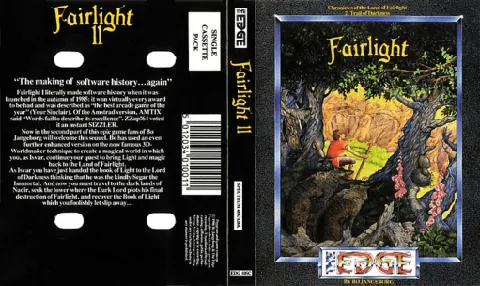
Fairlight
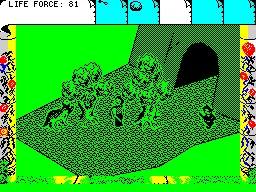
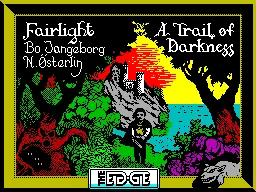
Fairlight was released in 1985 by The Edge as an isometric action-adventure that takes the player into the castle of the wizard Avan Cormak, where seven parts of a magical amulet needed to save the kingdom must be found. The game combines exploration of dozens of interconnected rooms with puzzles, item collecting, and combat against the castle's hostile guards, while the character has limited stamina and must watch out for dangers around them, from traps to guards to the need to keep an eye on the torch's burn time, without which orientation in the dark rooms is difficult and unexpected danger is easily encountered.
Visually, the game felt very mature for its time; the isometric graphics with finely drawn environments and atmospheric details made it one of the aesthetically most impressive games on the Spectrum that year, with elaborate interiors that varied noticeably from room to room and gave the castle the feel of a real, inhabited place. The controls were smooth and allowed for fairly precise platform jumping and item manipulation, which was rather rare among this generation of isometric games and set it apart from clunkier competing titles, where imprecise controls often led to needless loss of life. Music and sound effects accompanied the exploration of the castle in a restrained but functional way, and there was even an introductory theme tune.
Fairlight received very favorable reception and is still considered one of the aesthetically and gameplay-wise finest isometric adventures on the ZX Spectrum, compared to the work of Ultimate Play the Game. The game's success led to the release of a sequel, Fairlight II, which expanded the world and story with another playable hero. From today's perspective, it stands out especially for its visual style and smooth controls, which hold up even alongside later, technically more advanced titles in the genre, though its atmosphere is best appreciated today by players familiar with the period context of isometric adventures.
Why play it: For fans of isometric adventures who appreciate smooth controls and a visual style comparable to the work of Ultimate Play the Game, ideally with knowledge of the genre's period context.
Game 71 of 100 for ZX Spectrum