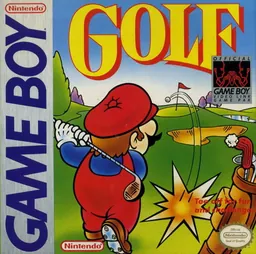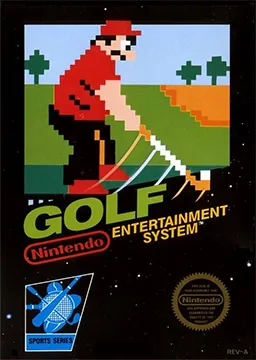
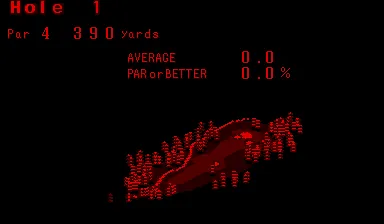
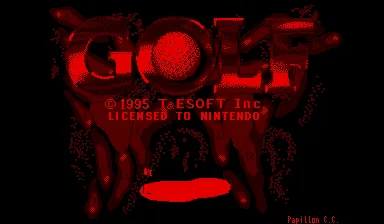
Golf is exactly the type of game on the Virtual Boy that makes it clear why Nintendo bothered with a stereoscopic display in the first place. Golf is a sport about judging distance, elevation and the slope of the green, and those are exactly the kinds of information a flat screen can only convey through numbers and mini-maps. Here, a glance is enough: the fairway stretches into the distance, bunkers and trees have a legible position in space, and judging whether you'll clear an obstacle suddenly becomes an intuitive call instead of studying tables. The engine comes from T&E Soft, a studio with plenty of experience making golf simulations on other platforms, and it shows in the polish of the details.
Mechanically it's the classic triple-press system: the first press starts a power meter, the second stops it, and the third determines the accuracy of the strike. On top of that there's a full set of clubs to choose from, direction settings, wind to account for, and on the green, slope reading shown via a grid. The player has access to a complete eighteen-hole course with varied hole layouts and can play for score or against an opponent. The difficulty is nicely balanced; a beginner can play a round without frustration, while an experienced player has plenty to work on trying to bring their score under par. The sound is austere, which suits golf well, since silence between shots reinforces concentration.
At the time it was seen as a competent title, though not exactly thrilling. That judgment still holds up in the end: it's not a game that surprises with a new idea, but rather a properly executed sports simulator using one hardware feature nobody else had. Today it's among the easiest Virtual Boy library titles to play, since it doesn't demand fast reflexes and turns short sessions into an asset rather than a limitation. Anyone who enjoys nineties golf games will find here an interesting and unusual chapter in their development.
Game 12 of 13 for Nintendo Virtual Boy