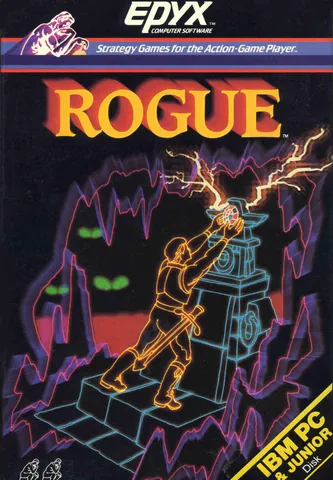
Rogue
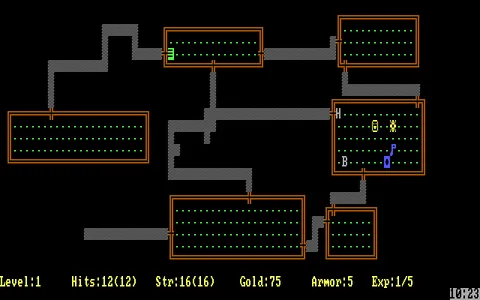
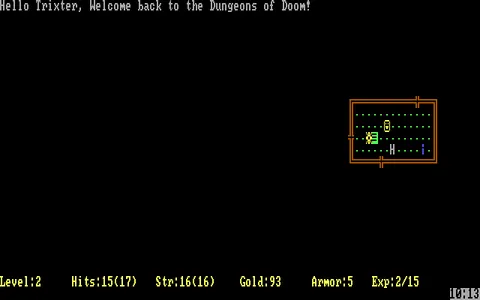
Rogue emerged in the late 1970s and early 1980s on university Unix computers — its creators were programmers Michael Toy and Glenn Wichman, later joined by Ken Arnold — and the game quickly became a legend: every expedition into the Dungeons of Doom looks different, because the computer regenerates the layout of corridors, monsters, and items anew each time it's launched. The player controls an adventurer who fights through ever deeper levels, rendered in ASCII characters, in search of the Amulet of Yendor, all while keeping an eye on the character's hunger, and death is permanent — the game must be started completely from scratch, as the saved position only serves to pause play, not to undo failure. This very combination of endless replayability, a turn-based combat system, and the tension of a single life gave the entire genre its name, roguelike, and later inspired offshoots such as NetHack, Moria, or Angband.
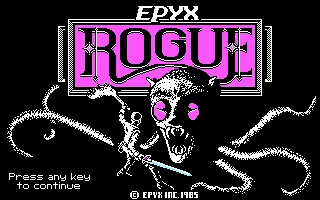
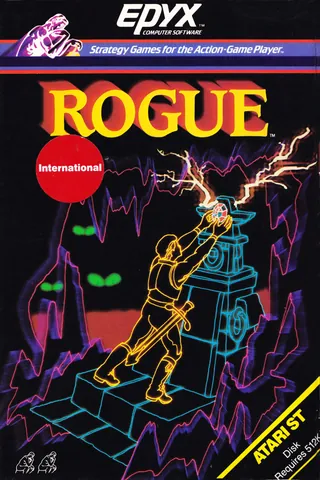
The 1984 DOS version by A.I. Design, published by Epyx, is among the very first commercial ports of the game from academic halls to ordinary home computers, to which it had previously spread only unofficially among programmers and students via university networks. The graphics remained purely text-based — rooms, corridors, monsters, and potions are represented by letters and symbols on a black background — and the controls were adapted for the IBM PC-compatible keyboard, including the well-known hjkl movement keys following the pattern of Unix text editors. Compared to the original university version, the main goal was to make the game accessible to a wider audience: the rules, dungeon generation, and difficulty were not fundamentally changed; the game simply received boxed packaging, a printed manual, and support for ordinary PC setups without needing access to a university Unix system or mainframe.
Why play it: This version is ideal for anyone who wants to experience the roguelike in its purest, most original form on what was then the most widespread home platform — with no graphical enhancements, just a keyboard and the pure logic of chance and risk on which the entire genre was later built.
Game 176 of 204 for PC / DOS (XT až 486)
The same title elsewhere (5)

 King's Quest VII: The Princeless Bride DOS Might and Magic: Secret of the Inner Sanctum DOS Might and Magic V: Darkside of Xeen
 Prince of Persia 2: The Shadow and the Flame
 Romance of the Three Kingdoms II
 An Elder Scrolls Legend: Battlespire
 The Elder Scrolls Adventures: Redguard
 Ultima VII Part Two: Serpent Isle