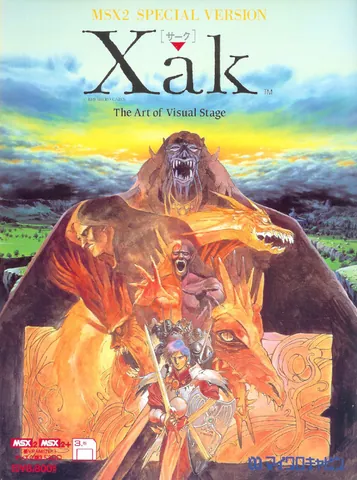
There is a handful of Japanese action RPGs that Western players know mainly by hearsay — and Xak is one of them. At first glance it looks like a Zelda clone, but a few minutes are enough to realize it is a carefully built fantasy world with its own mythology, in which humans, demons, and gods intermingle.
Xak: The Art of Visual Stage is built on a top-down view and real-time combat. The hero Latok moves through the landscape, swings his sword, and gradually grows stronger, but the essential thing is the atmosphere — the colorful town, dialogues with NPCs, the music, and the overall sense of adventure that was top-tier on the MSX2. Unlike purely action titles, story and the gradual unveiling of the world of Xak also play a role here.
The MSX2 was an ideal platform for this type of game: more colors, better scrolling, and better sound than the base MSX. Xak used this to the fullest and could visually measure up to the best that was being created on Japanese home computers at the time. For local players it was a brand that earned sequels and ports to other systems.
It is important to grasp the context. While Nintendo and Sega dominated in the West, the Japanese computer scene around the MSX, PC-88, and similar machines had its own stars and its own genre conventions. Action RPGs like Xak were among the pillars of this culture, and to this day collectors and retro-game fans seek them out as testimony to a parallel gaming history that reached us only in fragments.
If you are drawn to discovering titles outside the mainstream and want to see what a Japanese action RPG looked like at the peak of the MSX2's capabilities, Xak is exactly the kind of game worth getting to know — not least because of an atmosphere that ages surprisingly well.
Why play: For an atmospheric Japanese action RPG on the MSX2 that reveals a parallel gaming history most Western players largely missed.
Game 17 of 29 for MSX / MSX2