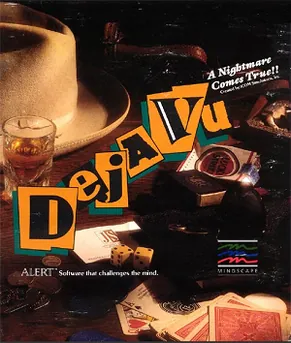
Deja Vu: A Nightmare Comes True
Deja Vu: A Nightmare Comes True brought a noir detective story to the Commodore 64 from ICOM Simulations, a studio known for its MacVenture system — an adventure controlled with a mouse and drop-down menus instead of traditional typed commands. The player wakes up as an amnesiac man in the men's room of a bar, blood on his hands and a corpse nearby, and must gradually reconstruct his own forgotten past, entangled with the gangster underworld of 1930s Chicago.
The gameplay is built on combining found items, thoroughly searching the environment, and choosing from a menu of actions such as Take, Use, Open, or Look, which was an unusual and intuitive solution on eight-bit platforms compared to the purely text parsers of the competition. The game also ran in real time, so the player was under constant pressure — long hesitation or bad decisions could gradually worsen the character's health or lead to other unpleasant consequences. The C64 version featured spare but functional graphics evoking a dark, cinematic atmosphere well suited to the hard-boiled detective genre and its typical clichés.
Deja Vu was praised for its atmosphere and innovative controls, and it helped popularize the so-called point-and-click adventure control scheme even before its later mass adoption by studios like LucasArts and Sierra On-Line. On the Commodore 64 it was one of the less common, and all the more interesting, ports of what was then a very popular graphic adventure genre, retaining a substantial part of the original versions' atmosphere on an eight-bit machine. The story also skillfully uses the theme of memory loss as a narrative device, letting the player uncover the character's past gradually, just as the character does themself. Today the game will appeal mainly to fans of noir detective stories and adventure genre history, though the pacing and period controls may feel somewhat archaic.
Why play it: For fans of noir detective stories and adventure genre history, Deja Vu offers an atmospheric tale of memory loss and an early point-and-click control system, though the period pacing calls for patience.
Game 82 of 121 for Commodore 64