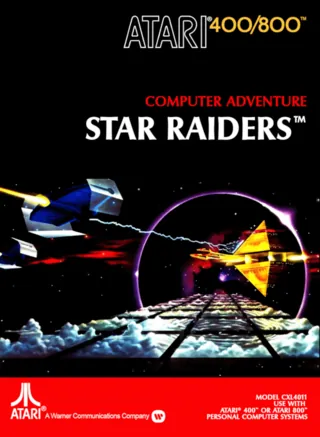
Star Raiders
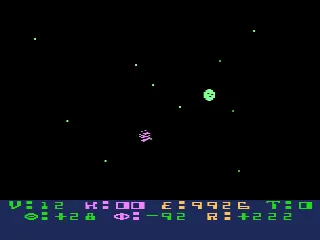
You sit in a fighter's cockpit, endless space stretches out before you, and enemy ships blink on the radar as they close in. All of this in 1979 — on an eight-bit computer. Star Raiders isn't just a game, it's a revelation that was years ahead of its time and forever shaped what space simulators look like.
Unlike the static shooters common at the time, Star Raiders put you directly in the pilot's seat and offered a first-person view of three-dimensional space combat. But the game wasn't only about reflexes: you had to watch a galactic map, manage the ship's energy, plan hyperjumps between sectors, and defend star bases against an invasion by enemies called the Zylon. This combination of action and strategy was utterly unprecedented at the end of the seventies and made Star Raiders an experience no one had known before.
The game was programmed by Doug Neubauer at Atari and released in 1979. It became a so-called killer app — a title that made people buy the Atari computer itself. It showcased the capabilities of Atari's eight-bit hardware in a way the competition had no answer for, and helped define what home computers could actually be used for even in the realm of demanding games.
The cultural significance of Star Raiders is enormous. The game is often called one of the very first cockpit-view space simulations ever, and you can find its DNA in the legendary Elite and other titles that consciously or unconsciously drew from it. The union of strategic resource management with action combat became a template for the whole genre, and Star Raiders still appears on lists of the most influential games in history.
Even after more than four decades, Star Raiders remains a fascinating work. Understanding its systems and becoming an effective commander takes effort, but its charm lies precisely in that depth. It's a game that proves visionary design can survive shifts in technology and stay captivating across generations.
Why play: Star Raiders is a cornerstone of the space-simulator genre — if you want to see where it all began, this visionary 1979 classic is a must.
Game 1 of 124 for Atari 800 / 8-bit
The same title elsewhere (1)
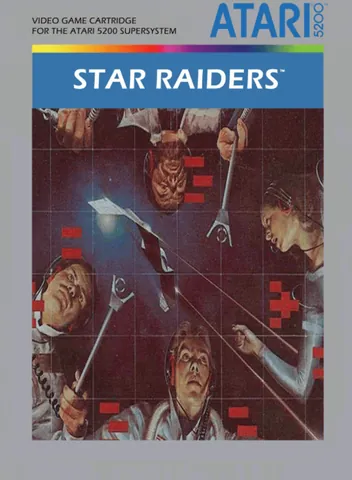
Star Raiders was created on Atari's 8-bit home computers, where the player combined a joystick for flying with a keyboard used to issue commands such as toggling shields or computing a course back to base. The Atari 5200 shares the same graphics circuitry as the 8-bit computers, so the starfield, radar and explosions look essentially identical — and the console's controller even has a built-in numeric keypad, letting commands be entered almost as conveniently as on the computer. The weak point remains the 5200's analog stick, which does not self-centre, so aiming precisely at enemy ships takes more practice than with a computer joystick. Content and visuals are essentially the same game on both machines.