You sit down in a plastic saddle, lean your whole body into the corner and a palm-lined road opens up before you. This was not just another video game, this was an experience that in the mid-eighties turned the arcade into an adrenaline arena. Hang-On is among the machines you don't forget, because it literally sat you on a motorbike.
The gameplay principle is clean and instantly comprehensible: you race along the track against the clock, pass checkpoints and each further section extends your limit. It is not a battle with other riders for position, but a fight against the passing seconds and your own nerves. A single mistake in the lean, one overdone yank of the handlebars, and you fly off the track. That very simplicity together with the relentless pace makes Hang-On a game you can pick up in seconds, but perfecting a run takes hours.
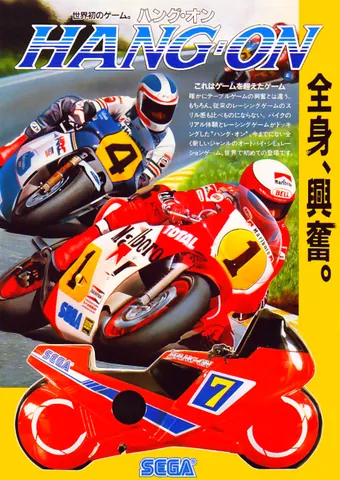
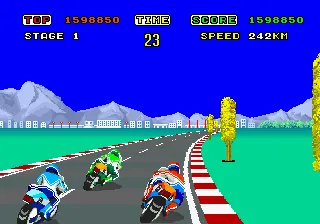
What truly makes Hang-On stand out is its presentation. Full-color, pseudo-three-dimensional graphics gave an illusion of speed that home computers of the day could not imitate. And then there is the legendary deluxe version with a movable motorbike replica: the player mounted it like a real machine and controlled the lean into corners with their whole body. This physical interaction was ahead of its time and became the harbinger of an entire genre of body-motion machines.
The game's cultural significance is enormous. Hang-On is often cited as one of the first representatives of so-called taikan, that is, hardware that simulates physical movement and pulls the player fully into the action. It opened the way to the later famous cabinets that combined power, movement and spectacular showmanship. For many arcade visitors it was the first moment when gaming ceased to be just buttons and a joystick.
To this day Hang-On is synonymous with the golden era of arcade machines, when engineers outdid one another in getting the player as deep into the game as possible. We hear its echoes in every later racing simulator with a movable seat and in every title built on the pure feeling of speed.
Why play: For the genuine feeling of speed in its purest form and for a piece of history that literally sat the player on a motorbike.
Game 67 of 258 for Arcade
The same title elsewhere (1)
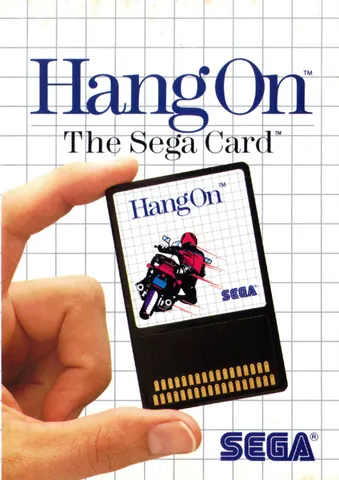
The arcade board had dedicated sprite-scaling hardware that could smoothly enlarge the road, palm trees, and rival bikes at a pace matching high-speed riding — and the cabinet itself added a moving motorcycle seat that tilted into turns. The Master System has nothing of the sort, so the conversion had to simplify the effect: the road zooms in more abruptly, there's less roadside detail, and the sense of speed is weaker than in the arcade. Controls are also reduced to a standard pad without any body-leaning. For the original adrenaline, you need the actual cabinet; the Master System offers a simplified but still playable home version.