Game studio
Konami (Hideo Kojima)
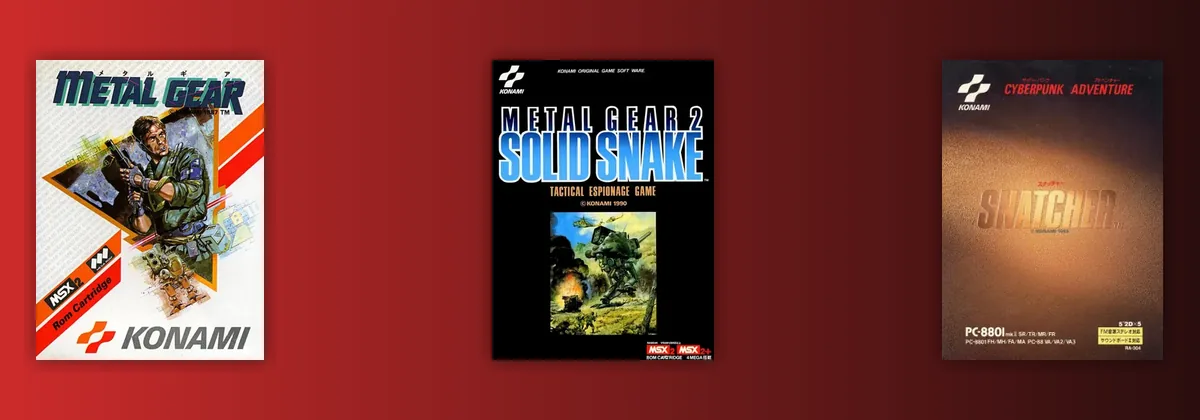
When the name Konami comes up in retro circles alongside Hideo Kojima, it does not mean arcade machines or whips against vampires, but an entirely different school of game design – a school in which story and atmosphere matter just as much as the game itself. It was precisely within Konami that the young Kojima launched the Metal Gear series on the Japanese MSX computer and built the foundations of the stealth genre, that is, play based on sneaking around and avoiding enemies rather than head-on gunfire. For fans of the classics, this branch of Konami is a legend because it showed how deep and cinematic a video game experience could be as early as the eight-bit era – long before "storytelling in games" became a fashionable term.
History
Hideo Kojima joined Konami in 1986 and almost immediately was put in charge of a project for the MSX2 computer platform. The result was Metal Gear (1987), a game that Kojima conceived against the conventions of the time: the player, in the role of soldier Solid Snake, was not meant to mow down enemies but to slip past them, hide, and advance unnoticed. This idea, born partly from the technical limits of the MSX, gave rise to the entire stealth genre. The game was a success and even got a conversion to the NES, though that was made without Kojima's direct supervision and diverged from the original in several respects.
On the MSX2, however, lies the sequel that many consider the true pinnacle of the eight-bit era: Metal Gear 2: Solid Snake (1990). Here Kojima pushed everything further – he added stealthier mechanics, more sophisticated artificial intelligence for guards capable of hearing footsteps or spotting the player in an adjacent square, and above all a far more mature, almost espionage-thriller story. For years this game did not reach the West at all and became a semi-mythical grail for European and American players.
Kojima's work on the MSX, though, was not limited to military action. He also left a significant mark on the genre of adventures and visual novels. After the cyberpunk adventure Snatcher came SD Snatcher (1990), an RPG reworking of the same world with cutely rounded "super-deformed" characters, a combat system, and a surprisingly dark cyberpunk story about androids called snatchers. Here too Kojima's signature is visible: a strong emphasis on atmosphere, dialogue, and cinematic scene direction.
Key Figures
The utterly central figure is of course Hideo Kojima – designer, writer, and director whose obsession with film seeps through every one of his titles. It was he who gave both Metal Gear and Snatcher their unmistakable tone.
The visual identity of the series was then fundamentally shaped by the artist Yoji Shinkawa, who joined Kojima later and became the go-to designer of characters and mechs. On the musical side, the Konami composing team deserves mention, whose sound capabilities on the MSX chip managed to coax suspenseful, cinematic melodies out of limited hardware, underscoring the stealthy play. Together these people formed the creative core from which a separate development group within Konami later grew.
Transformations and Transfers
Kojima's creative cell gradually took shape as a distinct brand and within Konami eventually became the studio Kojima Productions, which for many years functioned as an internal development team. Under the Konami banner, Kojima led the Metal Gear series to worldwide fame on the PlayStation and other consoles.
The idyll was not to last forever, though. In 2015, after protracted disagreements, the paths of Konami and Hideo Kojima parted. Kojima left the company, spun off the Kojima Productions brand as an independent studio, and departed along with a number of key collaborators, among them Yoji Shinkawa. This closed one of the most distinctive chapters in the history of Japanese game development – an era when something as auteurist and singular as Metal Gear was created inside a large corporation.
The Present
Konami still exists in 2026 as one of the great Japanese entertainment companies and holds the rights to the Metal Gear brand as well as to Kojima's other earlier titles created under its wing. In recent years the company has been rediscovering the value of its heritage and returning to classic series through collections and remakes. Hideo Kojima, meanwhile, continues on his own path at the independent Kojima Productions, outside Konami's structures.
For the retro community, however, that original Kojima era of Konami remains an untouchable classic. It was a period when Solid Snake was born on the modest MSX, when sneaking first took precedence over gunfire, and when games began to have the ambition to tell a story like a film. Metal Gear, its grand sequel, and the cyberpunk SD Snatcher still rank among the most precious things the eight-bit Japanese scene offered – and they remind us that some of the boldest ideas in the history of the medium arose within the tight constraints of long-forgotten hardware.
Games by the studio (3)
-
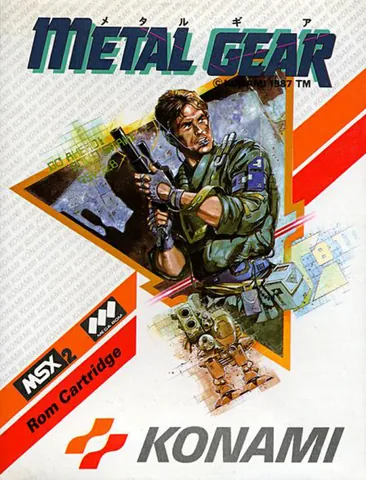
Metal Gear · 1987
-

Metal Gear 2: Solid Snake · 1990
-

SD Snatcher · 1990