Adventureland
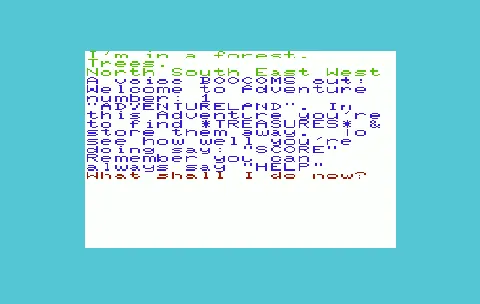
No graphics, just text on the screen - and yet a whole world of caves, swamps, and treasures opens up before you. Adventureland was one of the games that proved the most powerful graphics processor is the human imagination. On the Commodore VIC-20 it brought this magic into homes.
Adventureland was written by Scott Adams, a pioneer of text adventures on home computers, and it is one of the first text games available on microcomputers at all. The player enters simple verb-plus-noun style commands, explores the environment, collects objects, and solves puzzles with the goal of gathering hidden treasures. The conversion for the VIC-20 managed to fit an entire adventure into the extremely limited memory of the machine of the day, which was a technical feat in itself.
Gameplay rests on reading descriptions, logical reasoning, and experimenting with commands. Progress comes at the moment when the player combines the right object with the right situation or uncovers a hidden connection between locations. This form of storytelling, where the player fills in the scenes in their own head, was revolutionary at the start of the 1980s and laid the foundations of an entire genre.
Thanks to its affordability, the VIC-20 was a gateway to computers for many families, and text adventures like Adventureland showed that even modest hardware could carry a complex adventure if it leaned on words instead of pixels. It was proof that gaming didn't have to be only about action.
Scott Adams and his series of text games hold a crucial place in the history of games - they belong among the pioneers who carried the concept of adventure games from university mainframes onto machines accessible to ordinary people. Adventureland is often cited as one of the first commercial text adventures for microcomputers.
Why play: For the roots of text adventures, where you build the world of adventure in your own head from nothing but words and imagination.
Game 9 of 9 for Commodore VIC-20