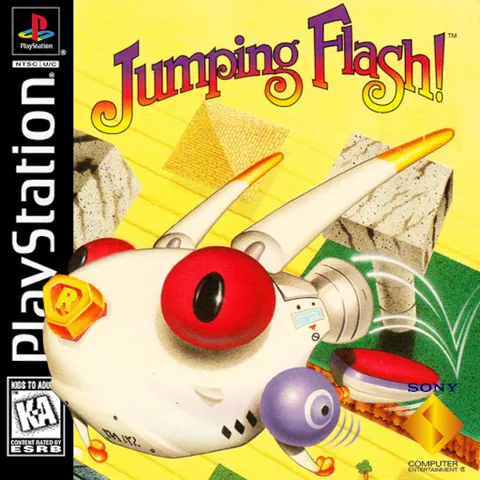
Jumping Flash!
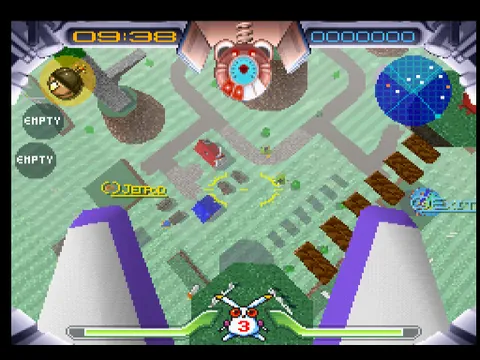
Jumping Flash! is one of the historically most important titles of the early PlayStation era, being among the very first to show what a fully-fledged first-person 3D platformer could look like. The player controls a robotic rabbit named Robbit, who hops between floating islands hovering high above a devastated Earth, collects carrots, and dispatches enemies with weapons directly from a first-person viewpoint. The combination of a first-person camera with the platforming genre was thoroughly novel at the time of release and demanded an unusual sense of spatial awareness from players, since judging jump distances had to be learned on the fly, mostly by watching the shadow on the ground rather than a direct view of the character.
On the technical side, the game elegantly demonstrated the capabilities of the new console — fast texturing, smooth camera rotation, and colorful, legible environments that, despite simple graphics, felt fresh and playful. The controls were built around a triple jump, which let Robbit soar high above the levels and look down on them from above, solving the classic problem of spatial orientation in first-person 3D. Each world had a distinct visual theme, from factory complexes to tropical islands, and grotesque bosses awaited players at the end of each set of levels. The level design was compact, with individual missions short but full of collectibles and small puzzles, meaning the game can be finished fairly quickly and still feels today like a fresh, lighthearted showcase of experimental playfulness from the nineties.
Contemporary reception was very favorable, the game became one of the showcase titles of the early PlayStation and received a sequel, Jumping Flash! 2. Its approach to spatial navigation and first-person camera foreshadowed later experiments with the genre, and it remains a beloved item among collectors and video game historians alike. As one of the few first-person titles that dared to embrace platforming pace instead of shooting, it also earned a reputation as a curious but functional experiment. Today it mainly stands as proof of just how much creators in the mid-nineties were still experimenting with what could be done with newly available 3D graphics, and as a pleasant, undemanding showcase of early console creativity.
Why play it: For its first-person camera and platforming pace instead of shooting — a functional and, even today, pleasantly undemanding showcase of early console creativity.
Game 117 of 215 for Sony PlayStation