Total Annihilation
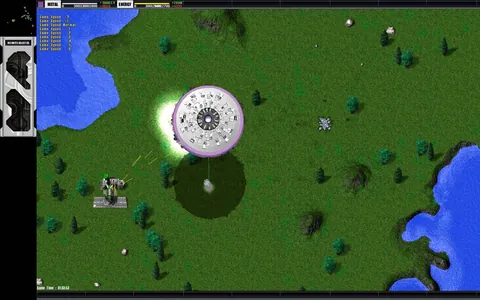
Total Annihilation arrived in 1997 as an answer to the question of what a real-time strategy game would look like if it weren't tied down by flat two-dimensional maps. The conflict between the Arm and Core factions is told as the tail end of a millennium-long war between two civilizations that have long forgotten why they're even fighting: one side replaced human bodies with machines, the other went its own way, and the planets between them have been burned to bare rock. The player doesn't start with a handful of villagers but with a commander mech capable of building an entire base from scratch, and the campaign gradually opens up dozens of missions on both sides of the front.
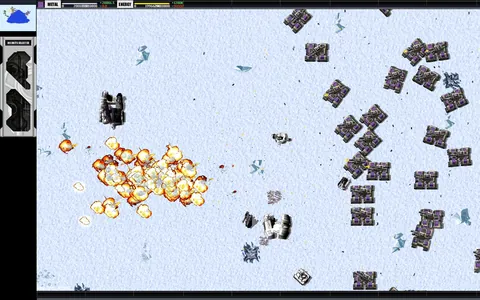
The economy rests on two continuously flowing resources, metal and energy. Instead of counting up batches, you track a balance of income and expenditure, so construction is more a question of throughput than stockpile, and wreckage of destroyed units can be recycled back into metal, turning the battlefield into a resource itself. Units are polygonal models moving across a heightmap, projectiles have real ballistics that can miss, ricochet, or hit something else entirely, and a hill in front of artillery isn't just cosmetic but an actual obstacle. On top of that come order queues, patrolling, automatic repairs, and radar coverage, tools the competition of the time was only just discovering.
Technically it was one of the first titles in the genre where you could comfortably command hundreds of units at once, and the orchestral, dynamic soundtrack lent the mass battles an unexpectedly grave, almost documentary war tone. Contemporary critics received the game very well, placing it alongside the genre's biggest names, even though it never commercially reached their scale. Its influence, though, is felt to this day: streamed economy, build queues, smart orders, and an emphasis on terrain all became standard, and a direct line runs from it to the later Supreme Commander series. The game is also kept alive by its community, unofficial patches, and open engines inspired by its design, so anyone who likes strategy games about logistics and masses of steel will still find a remarkably modern experience here.
Game 27 of 229 for PC / Pentium a Windows 9x