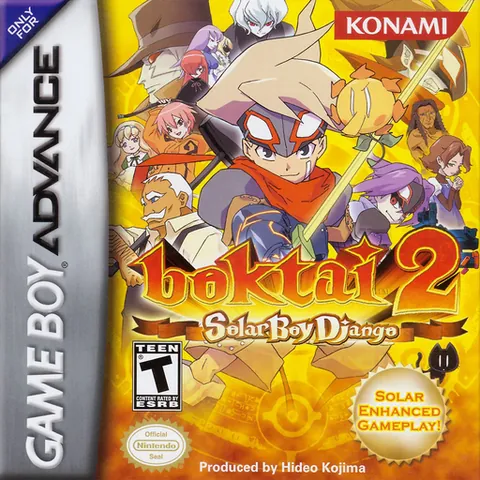
Boktai 2: Solar Boy Django
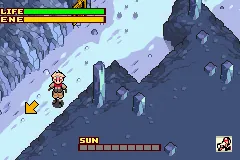
Boktai 2: Solar Boy Django continues the action RPG series that became known chiefly for the unusual technology built directly into its cartridge – a solar sensor that read real sunlight and converted it into energy for the hero's weapon, the Gun Del Sol. The player once again takes on the role of vampire hunter Django and sets out into a fantasy world full of undead enemies who can only be destroyed by light. The second installment expands on the first game's mechanics with new weapons, rideable mini-horses, more elaborate dungeons, and a plant-growing system directly tied to the amount of sunlight hitting the sensor. It also added the ability to transfer collected solar energy between players via a link cable, reinforcing the series' cooperative elements.
Gameplay combines a top-down view with gradual exploration of catacombs, solving simple light-and-shadow puzzles, and a combat system where ammunition has to be recharged using real sunlight – the player was thus forced to play outdoors or by a window, an unusual and much-discussed idea for its time. The graphics build on the first game, with detailed sprites and atmospheric, slightly darker locations, while the music underscores the gothic mood of vampire mythology, blending orchestral motifs with more melancholic tunes accompanying the nighttime passages. Behind the game was the Kojima Productions team under the Konami banner, which set it apart through its emphasis on atmosphere, storytelling, and cinematic staging of dialogue, unusual for handheld production of the time.
Contemporary reactions praised chiefly the concept's originality and the improvements over the first game, though the solar sensor was also a limitation – the game was considerably harder in cloudy weather or at night, forcing players to plan their play sessions around the weather forecast. Today Boktai 2 is remembered as one of the boldest experiments with Game Boy Advance hardware, and emulating it without the physical sensor requires special modifications or workarounds simulating sunlight. For fans of unconventional RPGs, it remains an interesting experience that shows how far Kojima's team was willing to go in linking a game to the real world, and in many ways it anticipated the industry's later interest in game peripherals connected to the physical environment.
Game 106 of 170 for Game Boy Advance