Blue Max
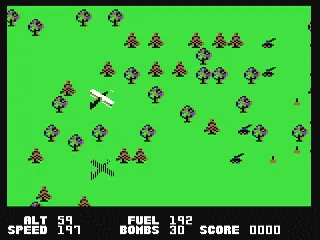
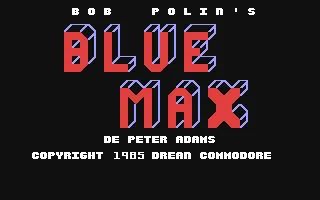
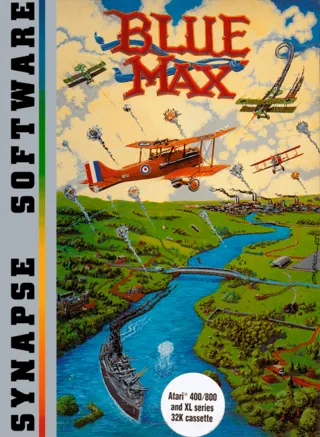
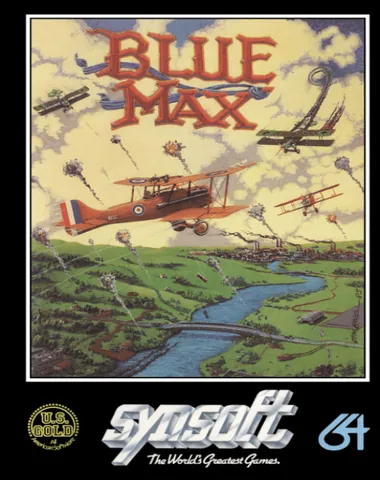
Blue Max puts the player in the cockpit of a German biplane over the battlefields of the First World War and offers a combination of side-view aerial dogfights with bombing missions over trenches, bridges, and railway stations. The game was created by studio Synapse Software and released on the Commodore 64 in 1983, at a time when flight simulations on eight-bit computers were still in their infancy and most competing titles settled for simple arcade shooting. The player has to keep an eye on fuel level, ammunition, and damage to their own plane, which set the game apart from purely arcade shooters and gave it a whiff of simulation, albeit with significantly simplified physics adapted to the capabilities of the hardware of the time.
The gameplay is built on alternating between two views – during flight, seen from the side, the player maneuvers between enemy aircraft and anti-aircraft fire, while during a ground attack the camera switches to a top-down view, similar to bombing arcade games of the era. The graphics use smooth scrolling, something the Commodore 64 was well equipped for in 1983, and together with the measured, atmospheric music create a sense of a lone flight over enemy territory, where every routing decision can mean the difference between returning to base and being shot down. The controls are simple but require a feel for speed and altitude, so hitting the terrain or a bridge means an instant end to the mission.
At the time of release, Blue Max was among the most successful and most-cited titles from Synapse Software and helped define the genre of aerial action simulations on home computers – a number of later biplane games set in the First World War drew inspiration from it and adopted its division of flight into a dogfight phase and a bombing phase. Today the game will mainly appeal to players interested in the history of the genre; the controls and graphics have naturally aged, but the clearly defined goal of every mission and the tension from limited fuel and ammunition resources keep it playable even decades after its release.
Why play it: Mainly for players interested in the history of aerial action simulations – the controls and graphics have naturally aged, but the clear goal of every mission and the tension from limited fuel keep it playable.
Game 57 of 121 for Commodore 64