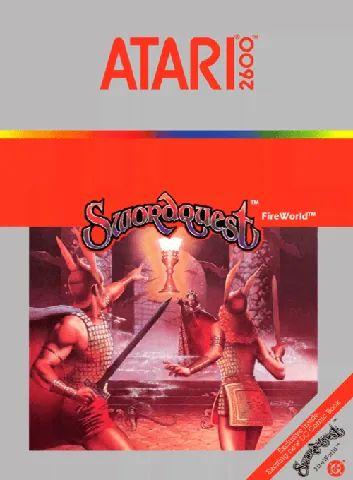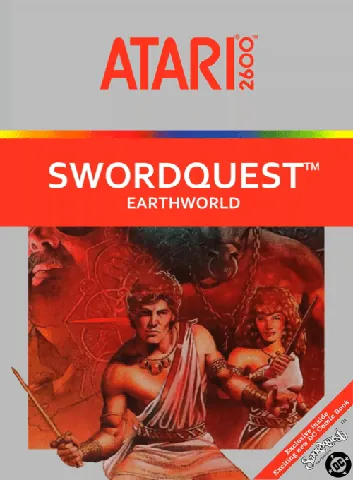
Swordquest: EarthWorld
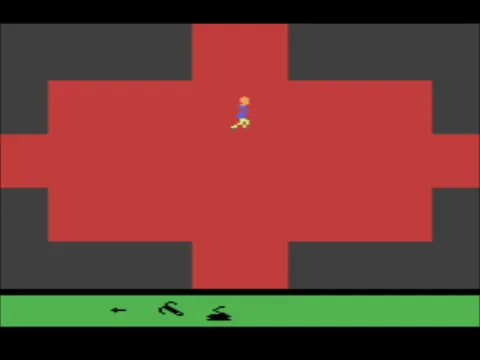
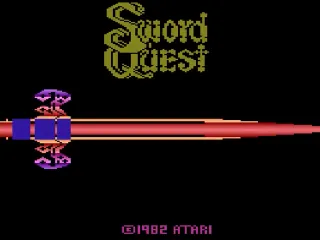
Swordquest: EarthWorld is a 1982 adventure released for the Atari 2600 by 20th Century Fox Games as the first installment of an ambitious series tied to a real competition for precious metal artifacts worth hundreds of thousands of dollars. The player moves through a series of individual screens full of puzzles, symbols, numeric codes, and dangers, collects scattered items, and tries to decipher the connection between the individual game screens and the included comic book from DC Comics, which contained the key to the overall solution. The game thus effectively functioned as a hybrid of video game and paper puzzle, a completely unusual concept in 1982 that is still considered one of the boldest marketing and design experiments of Atari's golden era.
Technically, it is a typical product of its time - simple graphics made up of geometric shapes and colored areas, minimal animation, and bare-bones joystick controls, with no textual guidance whatsoever within the game itself. This is precisely why the entire experience lives or dies on a well-thought-out puzzle system and on the tension of the player effectively solving a real competition with a real physical prize. The atmosphere is sparse, mysterious, and meditative, heightened by the game's silence, interrupted only by occasional sound effects when collecting an item or stepping wrongly into a trap, which forces the player to proceed carefully and systematically.
The contemporary reception was mixed - gaming magazines praised the idea of linking a comic book with a game but criticized the unclear objectives and frustrating progress without any in-game instructions or hints. Moreover, due to the crash of the American gaming market in 1983, the competition itself was never completed according to the original plan, turning the whole series into a legendary unfinished curiosity that collectors still speculate about today. Today, Swordquest: EarthWorld is played more as a historical artifact and evidence of how far the creators were willing to go beyond an ordinary game adventure toward linking multiple media into one unusual whole.
Why play it: For collectors and lovers of gaming history drawn to an unfinished legend that combines a comic book with a game - even at the cost of frustrating progress with no hints in the game itself.
Game 45 of 69 for Atari 2600