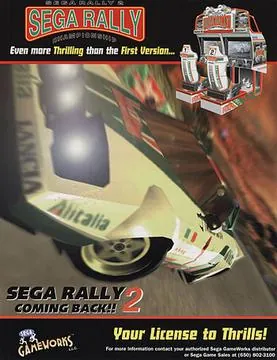
Sega Rally 2 built on the breakthrough success of the first game and moved rally racing to the more powerful Sega Model 3 hardware, delivering significantly more detailed tracks, more realistic vehicle handling on different surface types, and smoother graphics. Players choose from several cars and race across tracks through desert, forest, snow, and city streets, with the game emphasizing weight transfer, cornering slip, and adapting driving style to terrain that could visibly change over the course of a race as cars drove over it.
The cabinet was available in a hydraulic motion version that emphasized the car's body roll in corners and impacts on rough surfaces, making the experience physically intense in a way typical of arcade racing simulators of its era. The sound design relied on roaring engines, tires screeching on gravel, and energetic music accompanying players from start to finish, heightening the sense of speed through narrow forest sections. Linking multiple cabinets together let players compete directly against each other in arcades, a big draw at the time that attracted crowds of onlookers watching the battle for the best time.
Sega Rally 2 confirmed that the first game was no fluke and cemented the series' position as one of the founders of the modern arcade rally genre. Though it is sometimes overshadowed by its more iconic predecessor, fans of the genre value it for its improved driving physics and atmosphere, which many still consider the peak of 1990s arcade racing simulators, even though home ports never fully replicated it. For many players, the feeling of the hydraulically bouncing cabinet remains a memory that no home console could ever fully replace, which is why arcade racing fans still return to Sega Rally 2 even decades later.
Why play: For fans of arcade rally simulators, this is about improved driving physics and atmosphere that many consider the peak of the genre in the nineties, even though home ports never faithfully replicated it.
Game 171 of 258 for Arcade