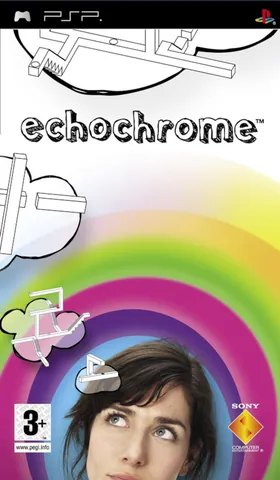
echochrome
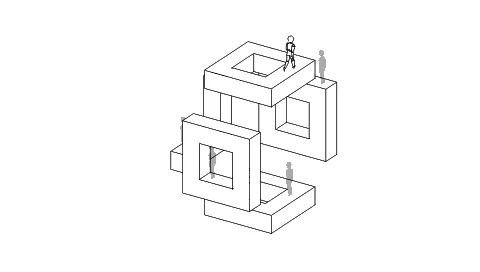
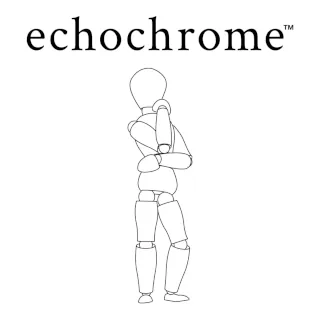
echochrome is a minimalist puzzle game built on optical illusions in the style of M. C. Escher's drawings. The player rotates the camera around a featureless wireframe figure walking along impossible staircases, bridges, and corridors suspended in empty white space, and must find the viewing angle from which seemingly broken paths visually connect into a single walkable route. The game has no combat or time pressure; it's purely about gradually discovering how perspective can trick the eye and turn an impassable structure into a path to the goal. Visually, the game relies on complete minimalism – a purely white background, simple wireframe structures, and a quiet, meditative atmosphere without music that might distract the player from thinking.
The PSP version launched alongside the release on PlayStation 3 in 2008, so it's not a later port but a simultaneous release for both platforms from the very start. The key difference is in the controls – the PS3 version allowed the player to rotate the camera around the scene by tilting the Sixaxis controller too, which gave the game a pleasantly physical feel of connecting hand movement to camera movement, while the PSP has no motion sensor, so the player controls the camera solely with the analog stick and directional buttons, which, despite the lack of tilt, remains precise and quick to master. The graphics were adapted to the handheld's smaller screen and lower chip performance, but the puzzles themselves, the levels, and their order remained the same between both versions. For a game whose core rests purely on thinking about perspective and viewing angle, the absence of controller tilt removes one control input and changes the feel of playing, but it has no major impact on the actual difficulty and solving of the puzzles. Thanks to the PSP's portability, the game also suited occasional play in shorter sessions, while on PS3 it was more of a settled-in session in front of the TV with the controller in both hands. Both versions also share the same system of unlocking further sets of levels based on how many puzzles the player has already solved, so progression through the game remains equally structured on both platforms.
Why play it: Puzzle fans will be pleased that the PSP version launched alongside the PS3 version and offers the same puzzles and levels, just with the camera controlled purely by the analog stick instead of controller tilt.
Game 64 of 122 for Sony PSP