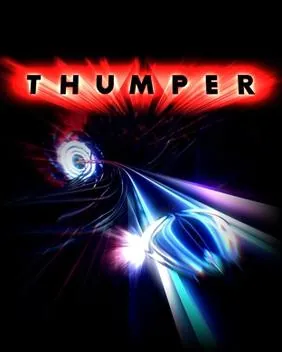
Thumper
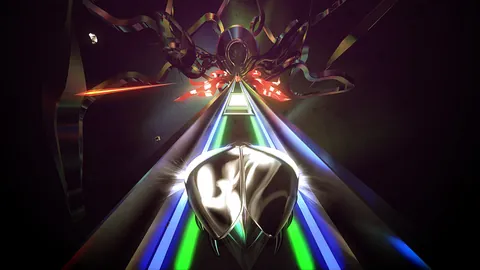
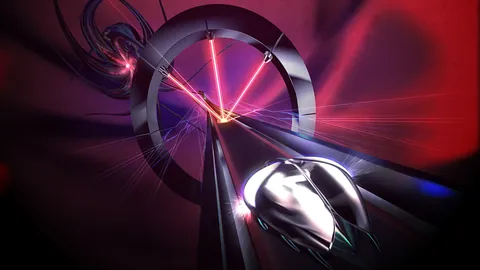
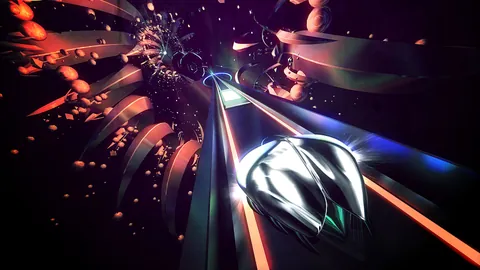
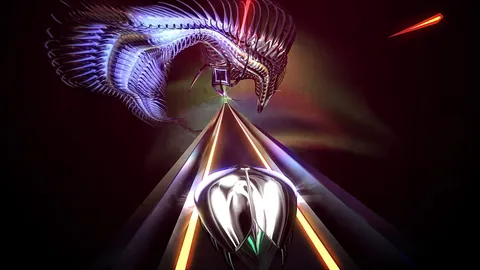
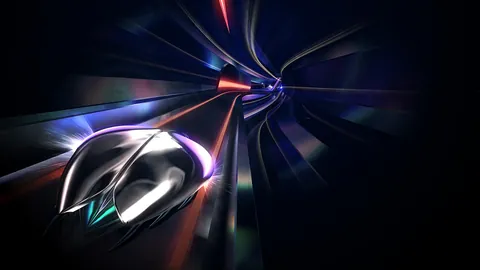
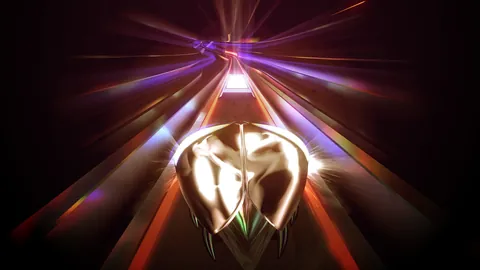
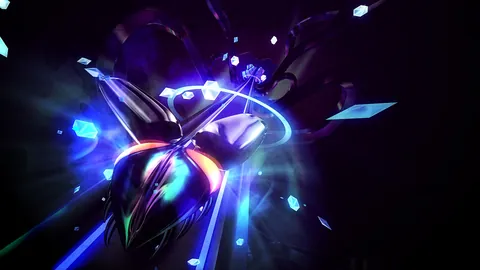
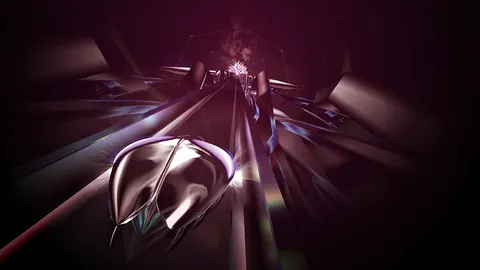
Thumper is a rhythm action game that its creators at studio Drool describe as rhythm violence – the player steers a metal beetle hurtling along a curved track and must, in precise time with the music, perform dodges, slams into turns, and jumps over obstacles, or else crash and lose energy. Unlike classic rhythm games, where the player reacts to a notation displayed on screen, here the music is generated almost in sync with what's happening on the track – every impact, turn, and jump creates a sound and bass accent, so the game and soundtrack merge into one continuous stream of tension. The tempo gradually accelerates and the levels grow in complexity until the game demands an almost meditative concentration and learned reflexes.
In the PSVR version, this already-intense game gains an additional dimension, because the spatial perception of the rapidly approaching track and the dark, metallic aesthetic amplify the sense of real speed and pressure. The visual style is dark, industrial, and minimalist, with sharp contrasts of light and shadow that feel far more urgent in a headset than on a flat screen. The audio – deep bass, metallic grinding, and wailing effects – is the core of the whole experience, and the game deliberately uses it to evoke physical tension, almost discomfort, which the creators described as part of the intended impression.
Thumper was received at launch as one of the most original attempts to combine a rhythm game with intense action and a test of reflexes, and the VR version was often cited as the most powerful way to experience the game, precisely because of the spatial immersion in speed and dark atmosphere that a classic screen can't match with the same physical urgency. The game influenced later rhythm titles by showing how deeply music can be organically tied to game mechanics, and it is still cited today as an example of how VR can amplify even seemingly simple game rules, provided the entire audiovisual design is built from the start with the player's spatial perception in mind.
Why play: For fans of rhythm games craving adrenaline, where music and reflexes merge into one – spatial immersion in VR gives the pace a physical urgency that a flat screen can't offer.
Game 16 of 28 for PlayStation VR