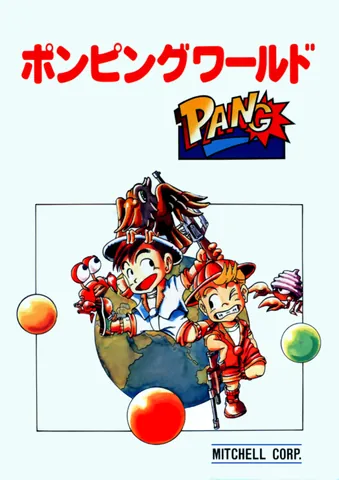
Pang
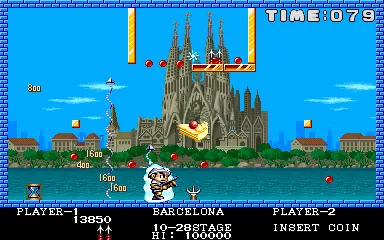
A ceiling above your head from which a giant bouncing balloon descends – and all you have is a harpoon aimed upward. You hit the balloon, it splits into two smaller ones, those into even smaller ones, and suddenly the whole screen is in motion and you're dodging for your life. That's Pang, a brilliantly simple arcade concept that grabs you within a second.
Pang came out in the late 1980s and rests on the perfect tension between order and chaos. Your task is to shoot down all the balloons in a level, but every hit briefly makes the situation worse – a big balloon shatters into faster, smaller ones. So you have to think ahead, manage your space and not let yourself get backed into a corner. Add to that power-ups, double and grappling harpoons, ladders and obstacles that turn every round into a little real-time logic puzzle.
The game's strength lies in cooperation. With two players Pang is unforgettable – coordinating who pops which balloon and who dodges is both fun and frustrating at once. The traveling backdrop of the individual levels, where you move across the world's famous landmarks and cities, gives the game an unmistakable charm.
In your brief, this title falls into the broader family of top-tier arcade puzzle games. Alongside Pang there's, for instance, Puzzle Bobble (also known as Bust-A-Move) with its endlessly addictive mechanic of shooting colored bubbles and its excellent versus mode, or the lightning-fast Magical Drop. What they have in common is that a simple rule can generate hours of tension and a craving for another attempt.
Pang became a fixture, received a number of sequels and ports to home computers and consoles, and appears in modern compilations and remasters to this day. It belongs among titles for which time plays no role – you grasp the rules in a second, but true mastery demands hours. It's precisely this immediacy that's the reason it remains popular across generations.
Why play: Instantly understandable, devilishly addictive and unforgettable with two players – Pang is the essence of why we fed the arcade one coin after another.
Game 47 of 258 for Arcade